Wastewater Treatment for Environmental Sustainability at Walailak University in 2025
Wastewater Treatment for Environmental Sustainability at Walailak University in 2025
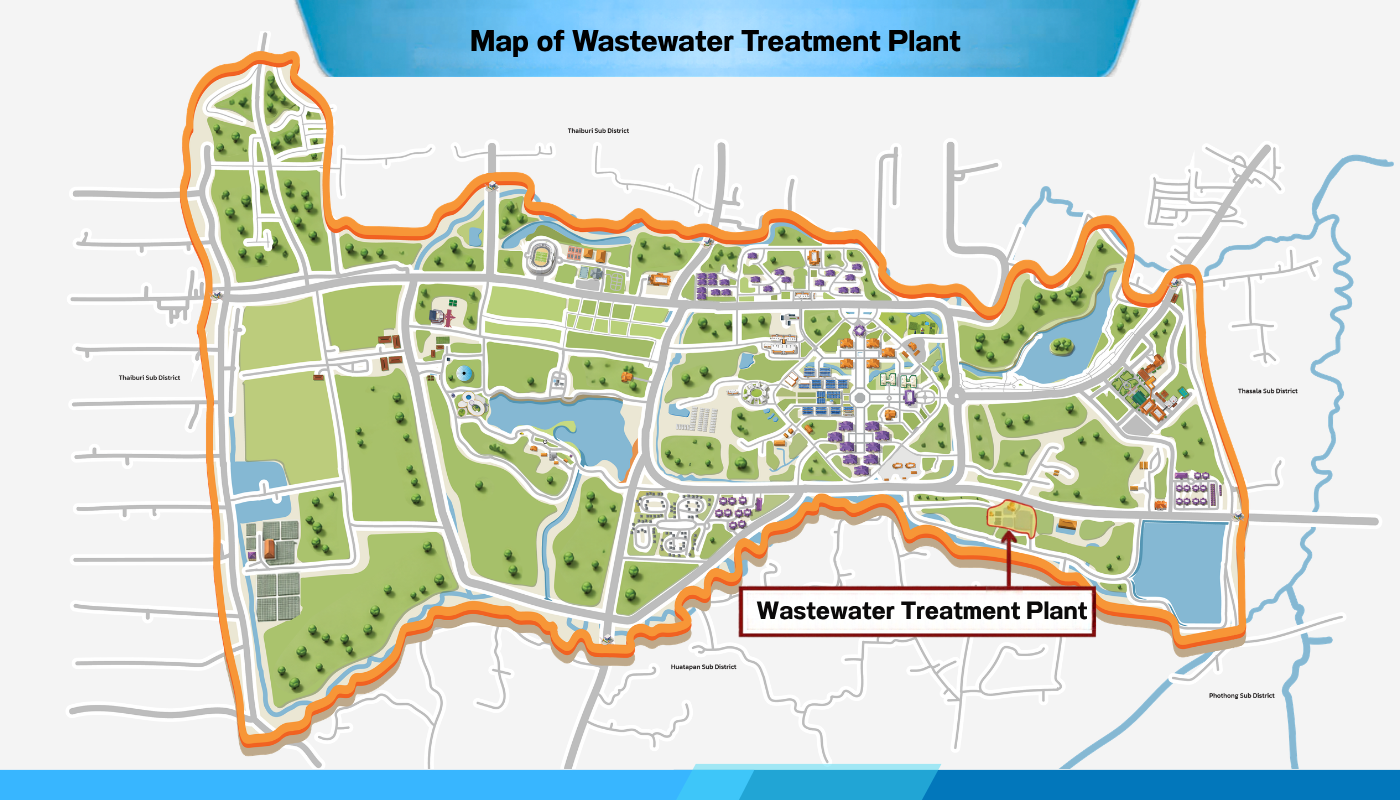
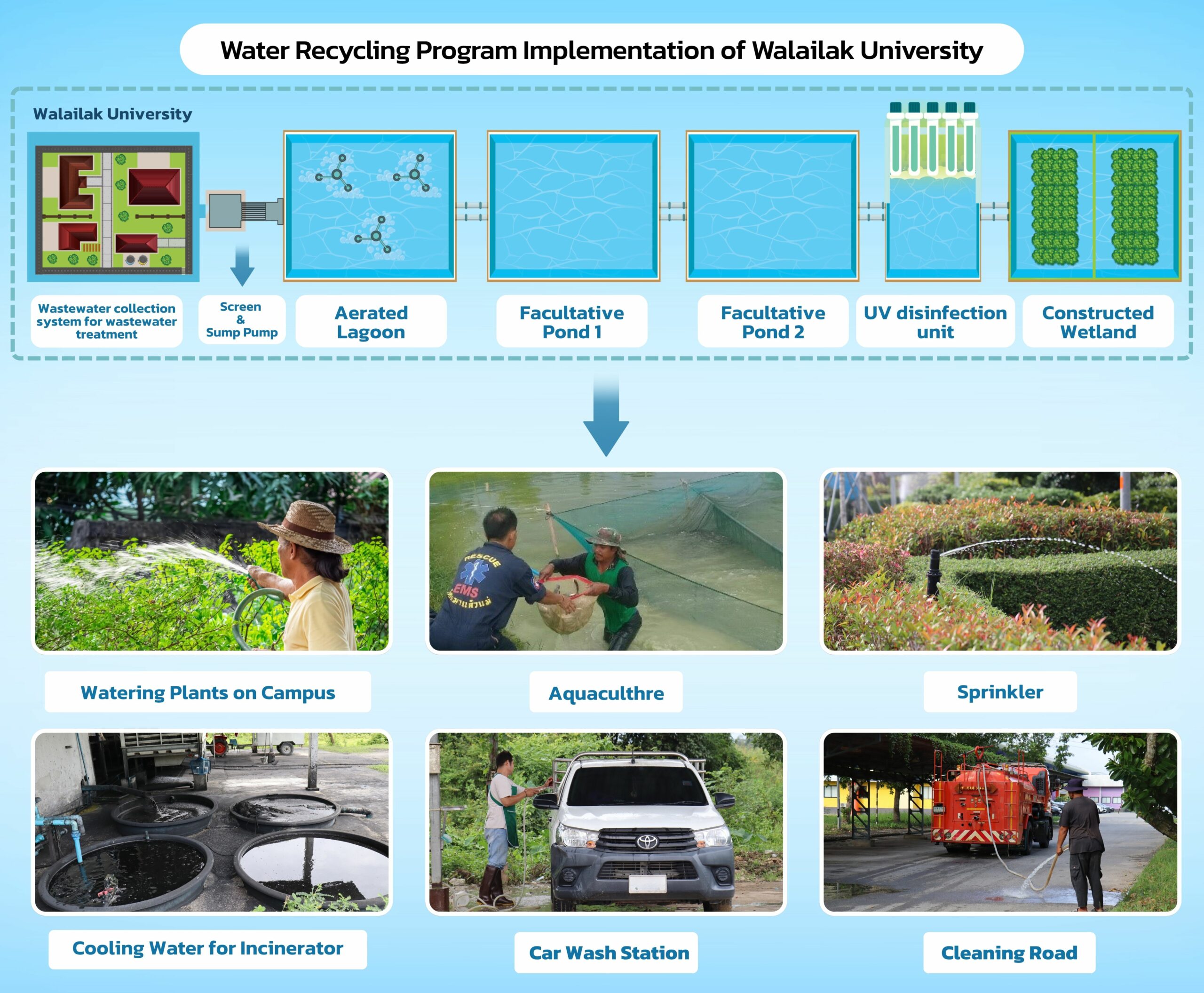
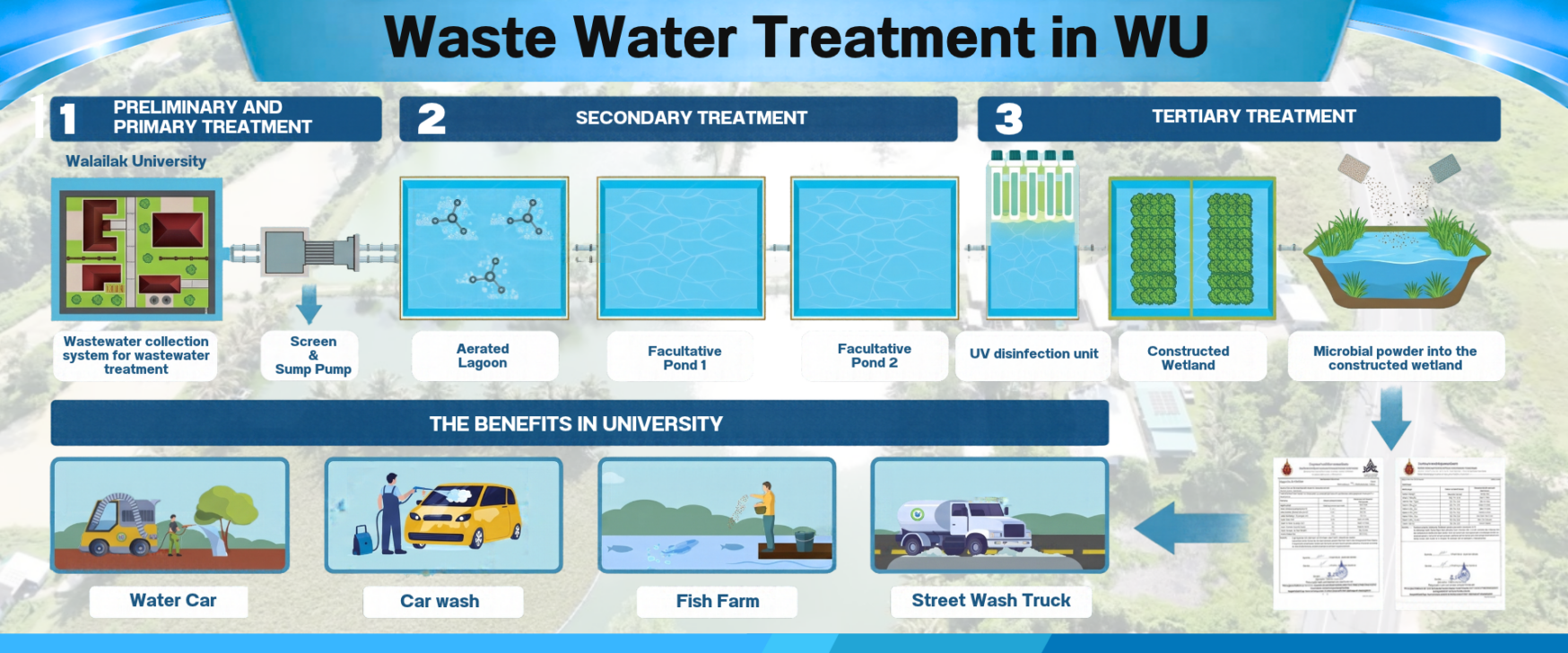
Walailak University (WU) has established and maintained a wastewater treatment process in place to manage wastewater generated from the daily activities of students and staff, including bathing, laundry, dishwashing, and toilet use. Since 2002, the university has implemented a wastewater management system development project to ensure that wastewater generated on campus is systematically collected and treated before reuse or discharge into natural water bodies. The university operates a wastewater treatment system with a capacity of 4,000 cubic metres per day, integrating biological treatment, disinfection, and water quality monitoring to reduce pollutants and maintain treated water quality.
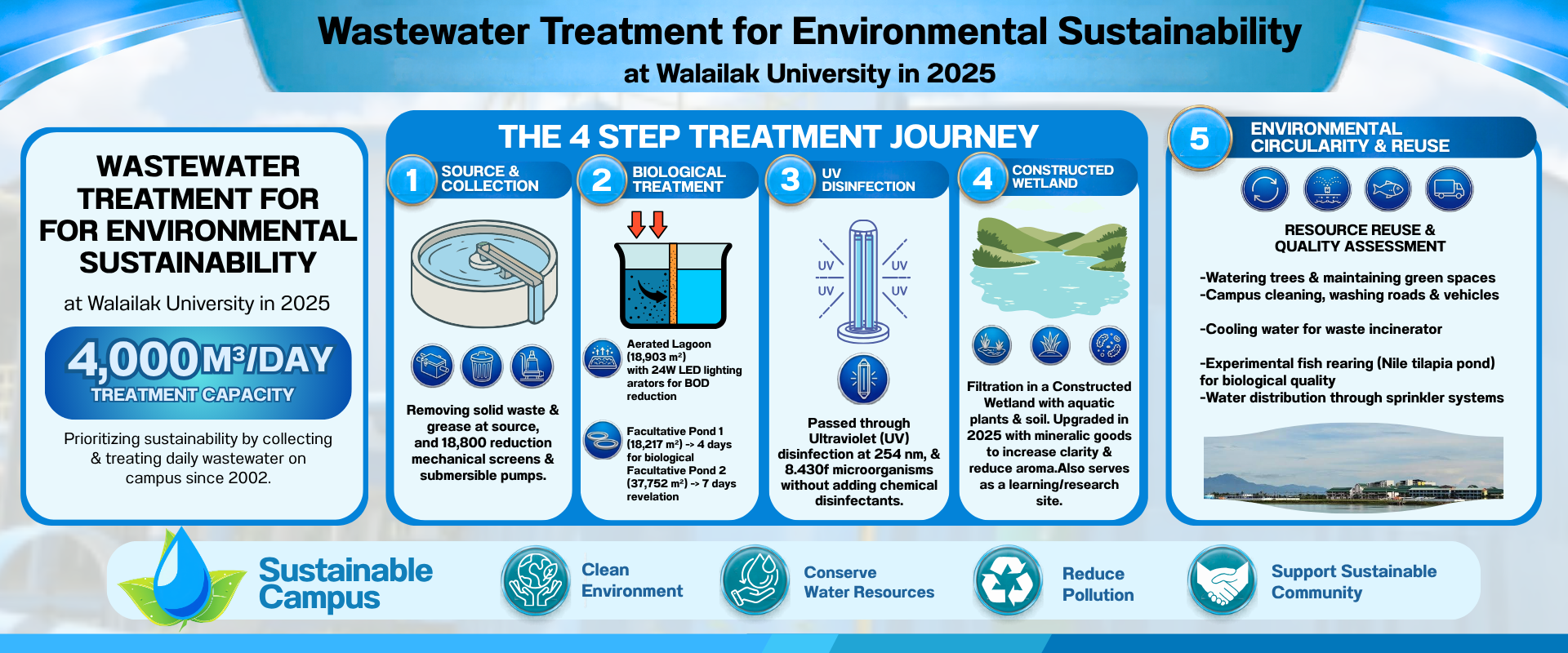
In 2025, the university continued the implementation of its established wastewater treatment process, covering pollution reduction at source, wastewater collection, treatment system operation and control, and water quality monitoring before reuse or discharge. To further enhance treatment efficiency, WU introduced microbial powder into the constructed wetland as an additional treatment measure aimed at improving water clarity and reducing ammonia concentrations during the final stage of the wastewater treatment process. These ongoing operations demonstrate the existence of an operational process to treat wastewater, supporting effective wastewater management, water pollution prevention, and sustainable water resource use across the university.
Wastewater Management at Source and Wastewater Collection
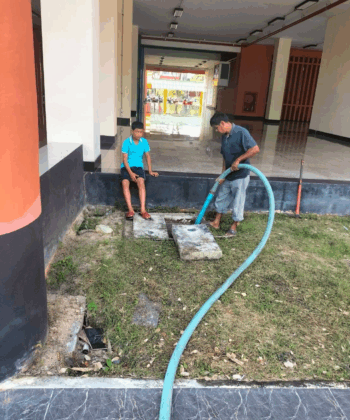
The university begins its wastewater management process by removing solid waste and grease before wastewater enters the treatment system. Grease traps are installed at university canteens, and accumulated grease is systematically removed to reduce contaminants and prevent blockages that could affect wastewater collection and treatment.
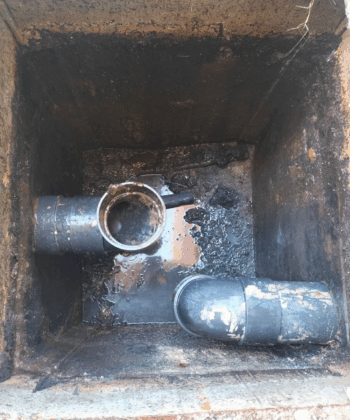
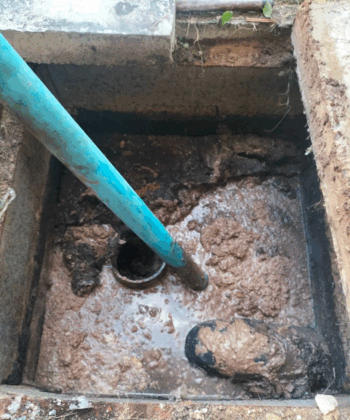
Wastewater from university buildings is collected and pumped to the wastewater treatment plant, where it passes through a motor-driven fine mechanical screen equipped with an automatic cleaning brush. This process removes remaining solid waste and prevents blockages in the submersible pumps before wastewater enters the biological treatment process.
Biological Wastewater Treatment
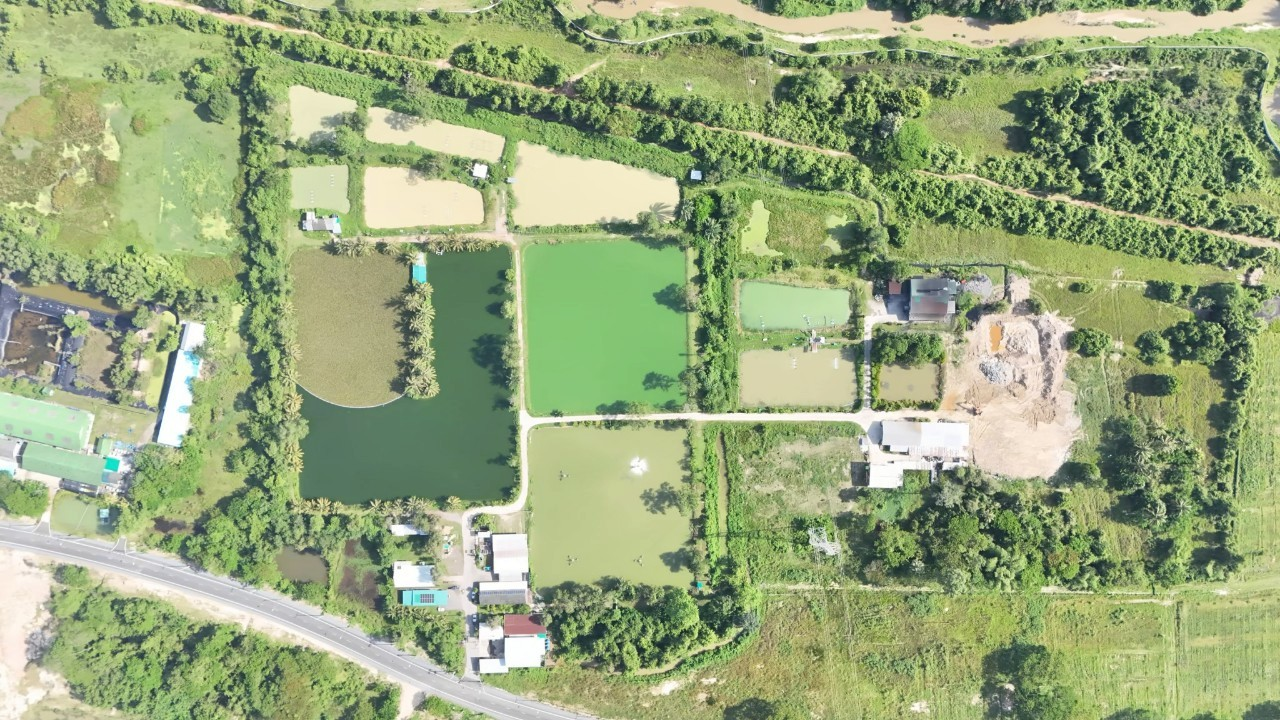
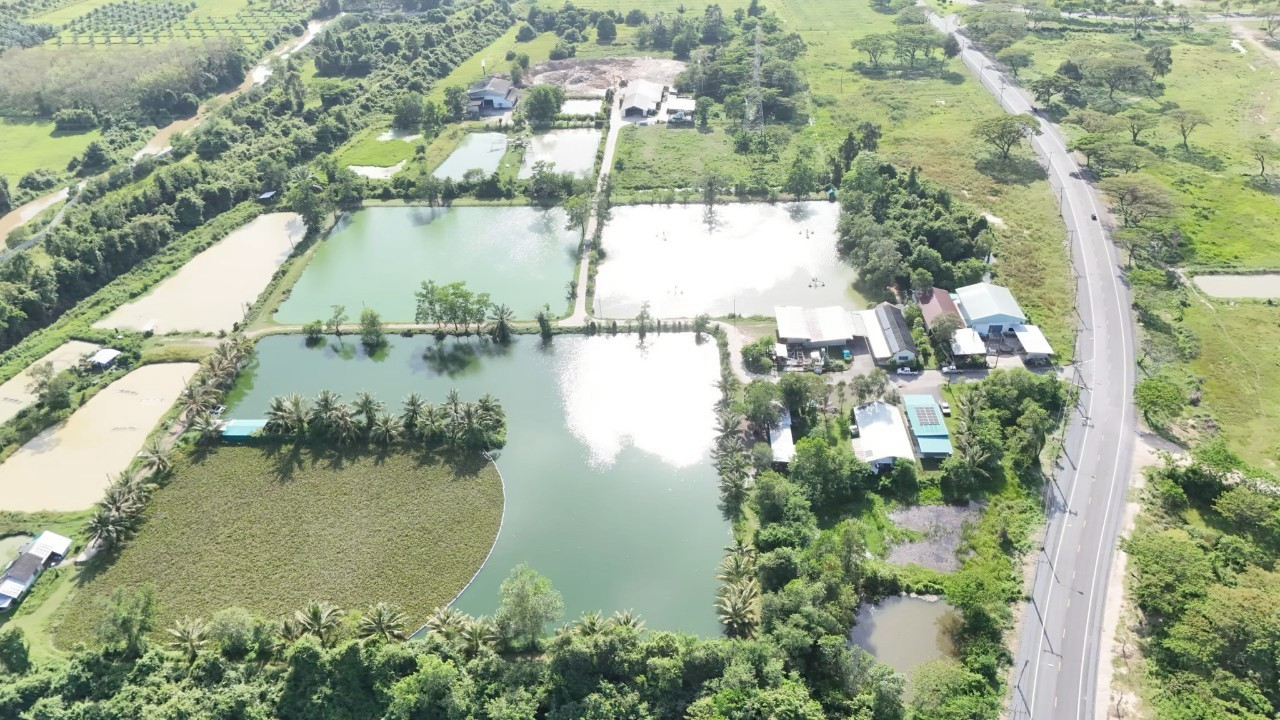
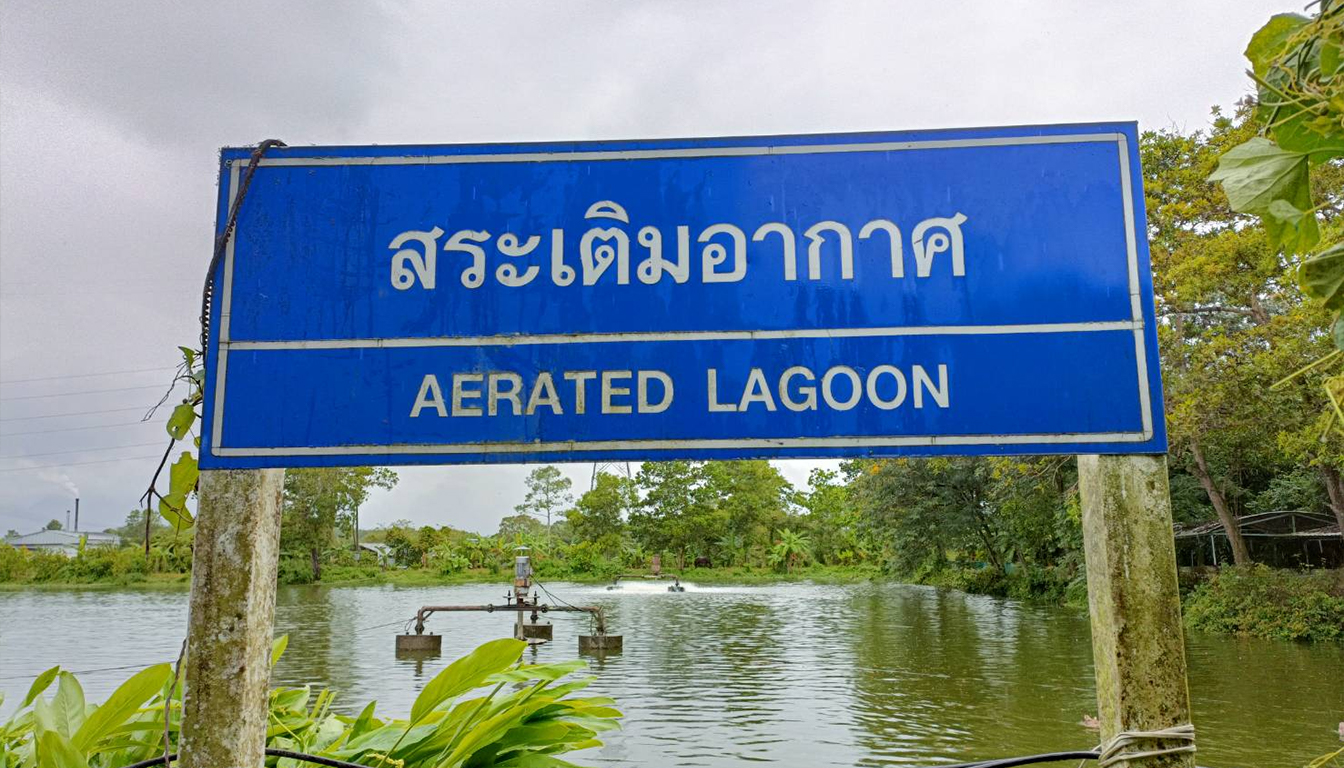
The biological treatment process consists of an aerated lagoon followed by two facultative ponds. These units operate in sequence to break down organic matter, reduce pollutant loads, and progressively improve water quality.
Aerated Lagoon
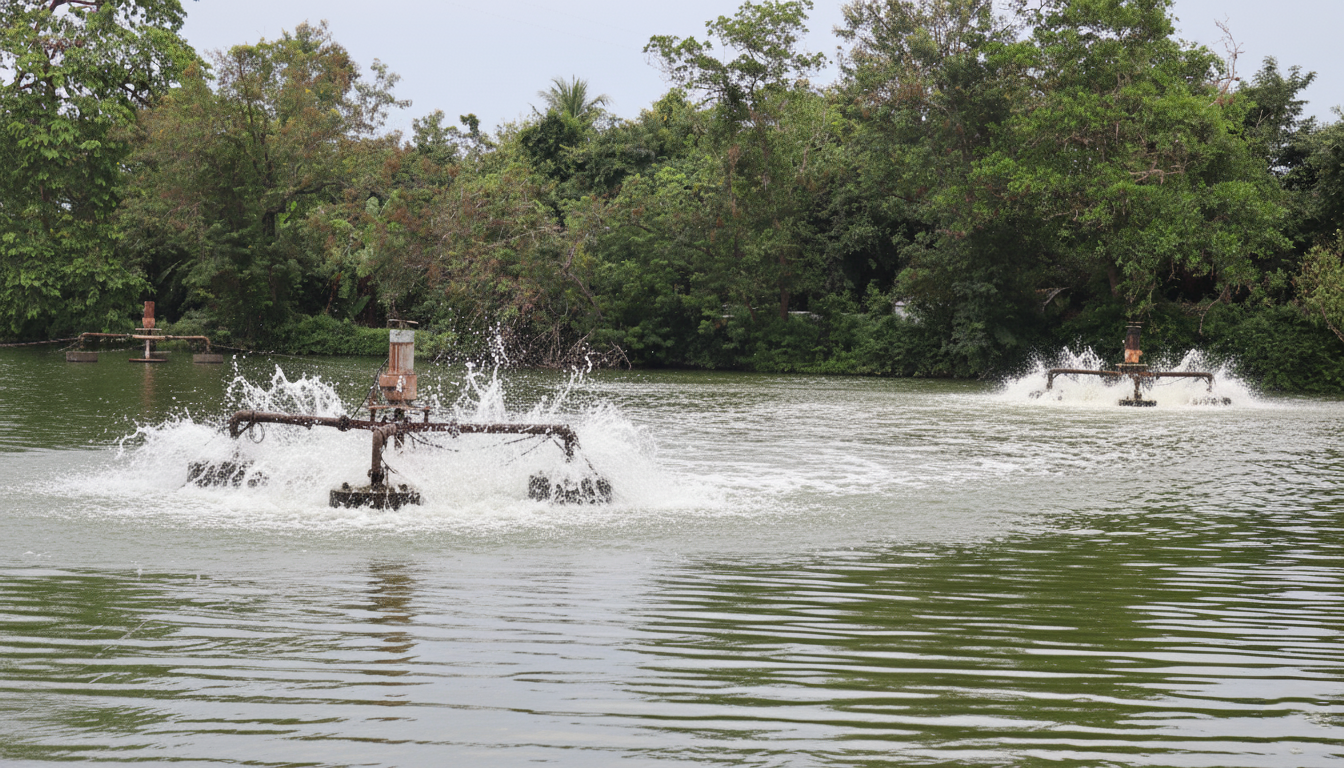
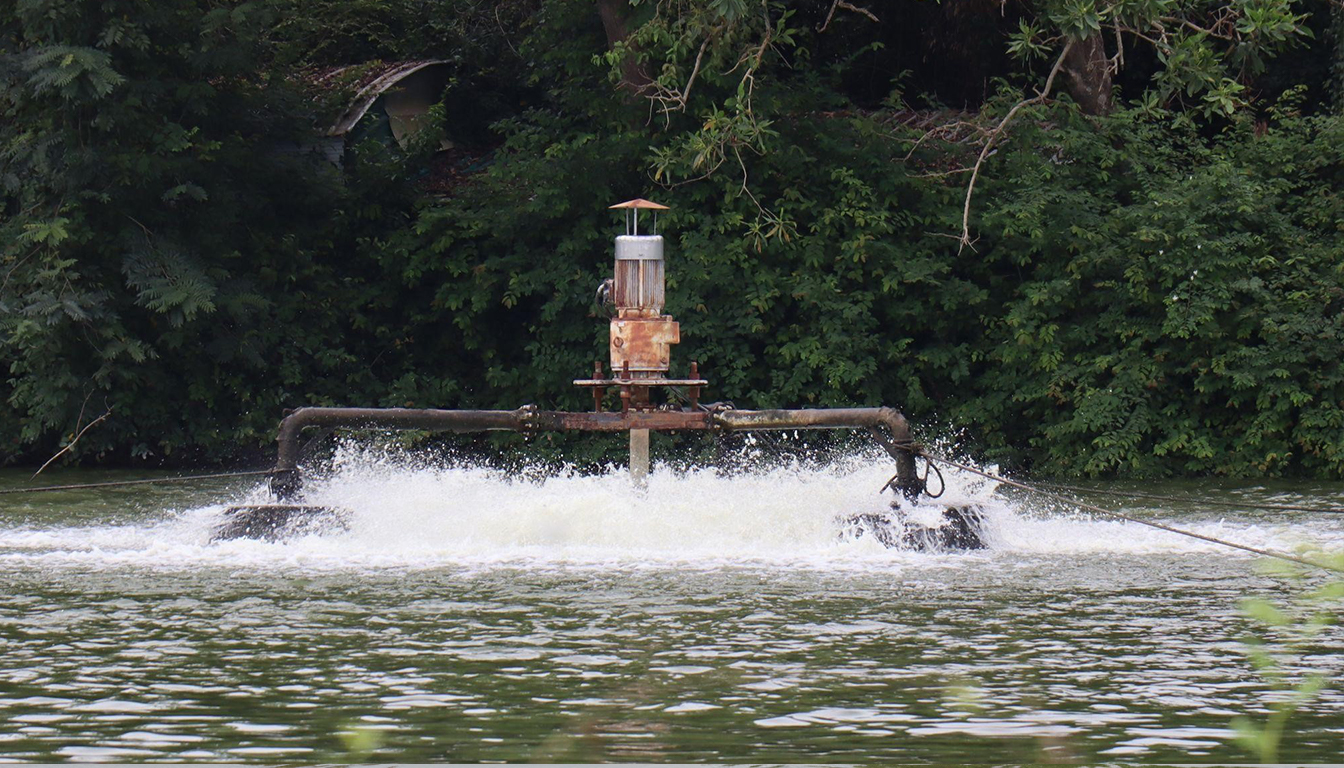
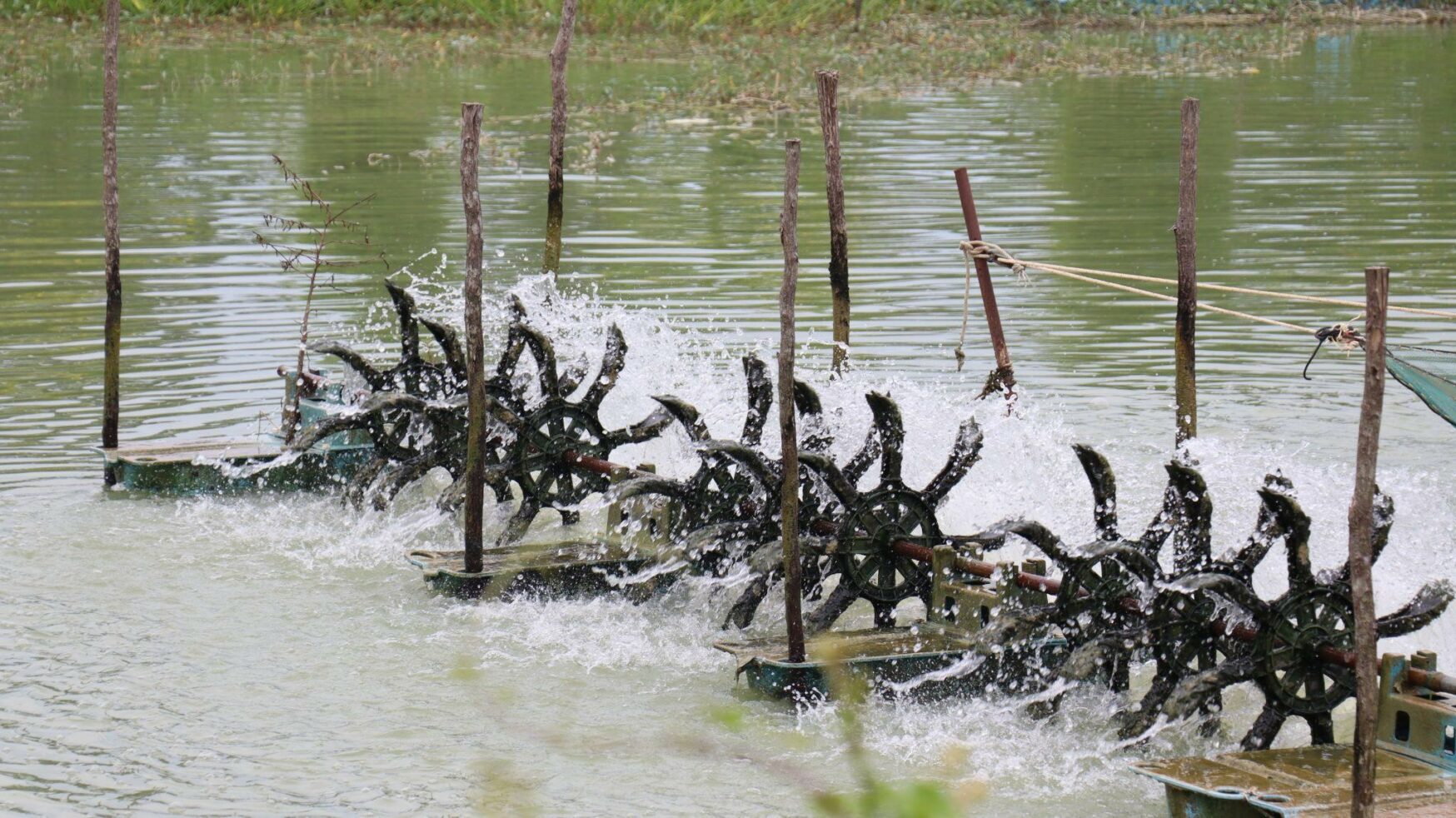
Wastewater is pumped into an aerated lagoon approximately 5 metres deep, with a capacity of 18,903 cubic metres. The lagoon is equipped with four low-speed floating surface aerators, each rated at 15 kilowatts, to supply oxygen and mix and circulate the wastewater. These conditions support aerobic microorganisms in breaking down organic matter and reducing biochemical oxygen demand (BOD). The university monitors dissolved oxygen (DO) using a sensor installed in the aerated lagoon. Monitoring data inform the operation of the aerators to maintain suitable conditions for wastewater treatment.
Facultative Pond 1
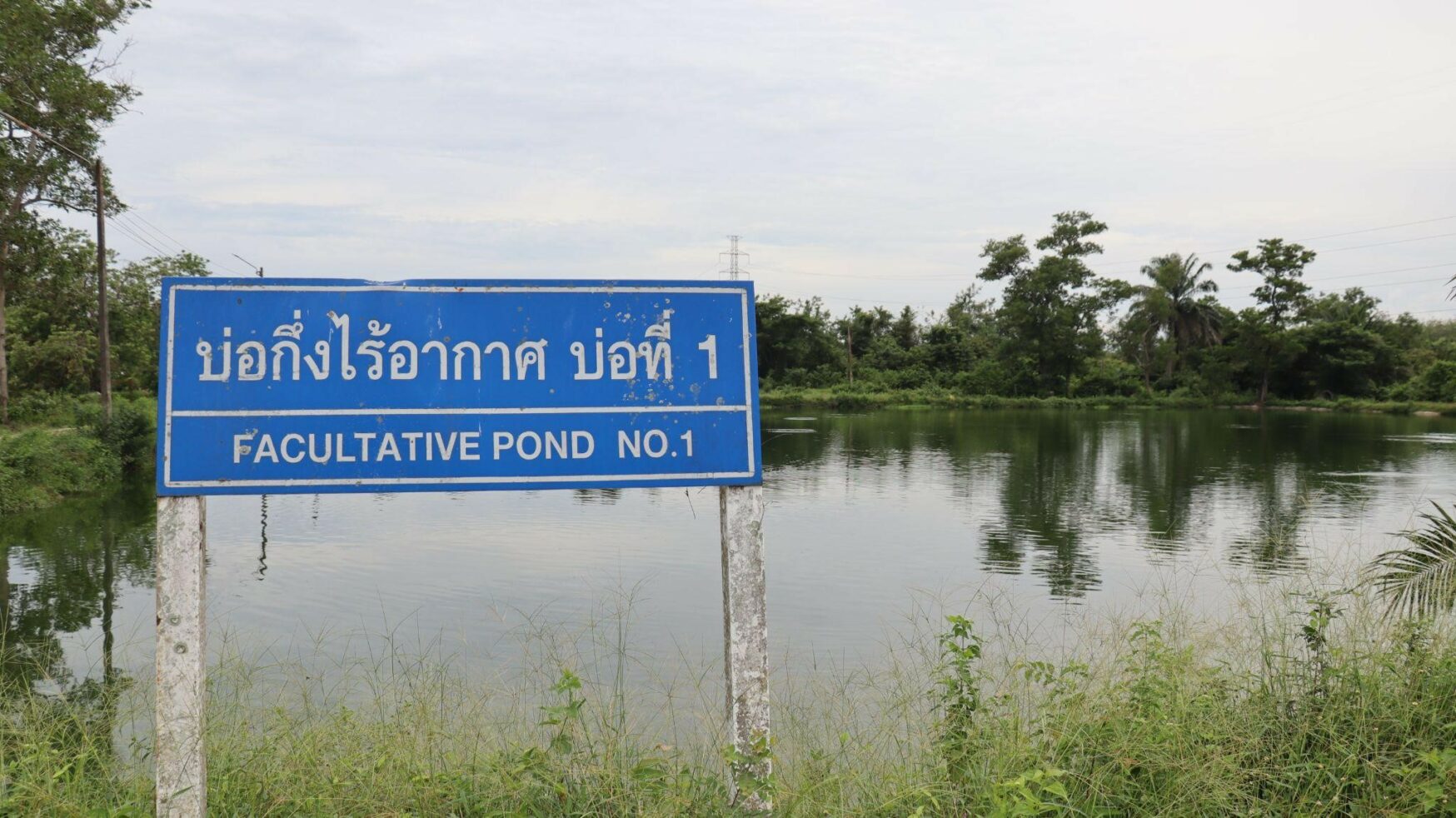
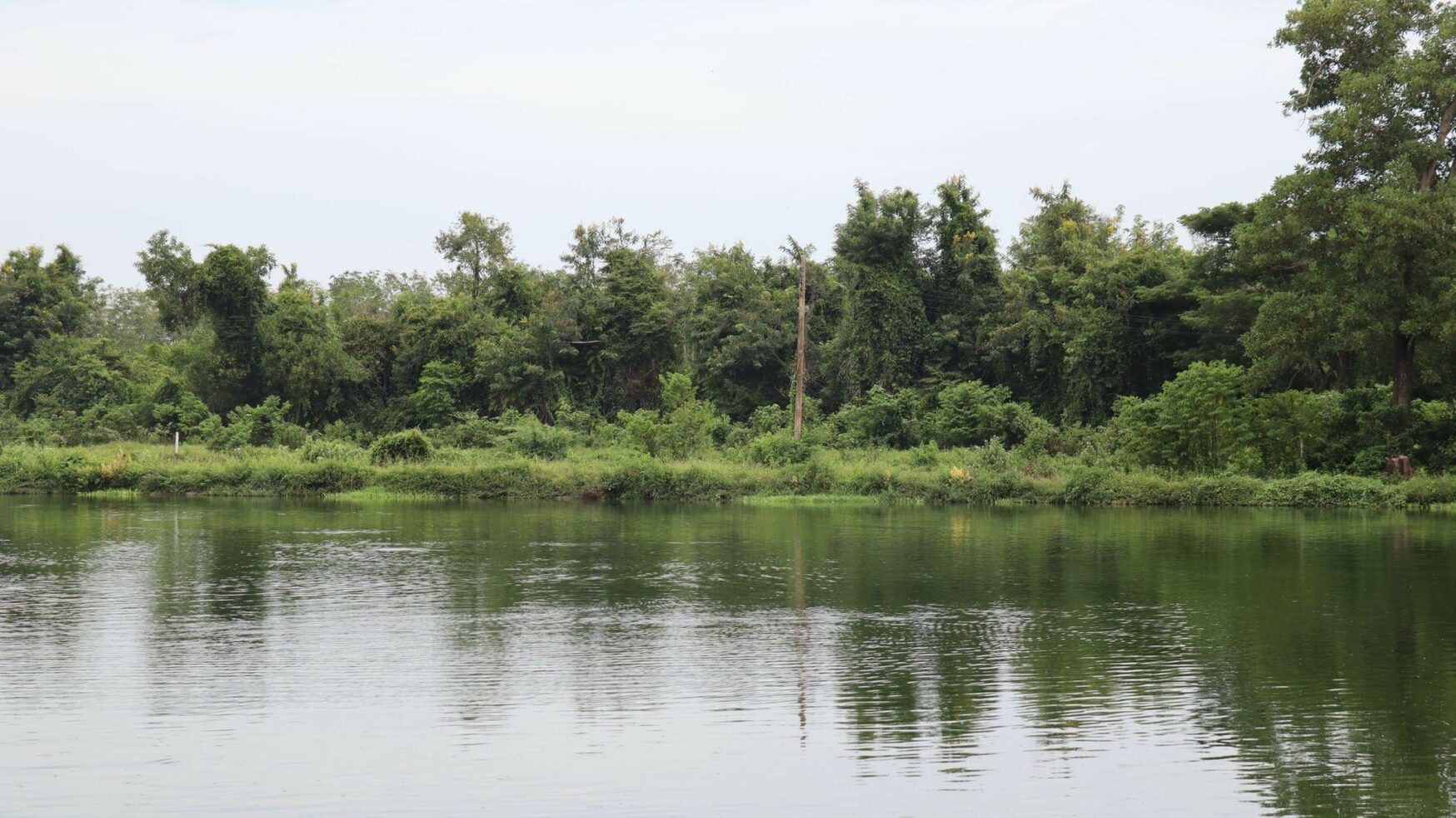
Water from the aerated lagoon flows into Facultative Pond 1, which is approximately 2 metres deep and has a capacity of 18,217 cubic metres. A retention time of more than four days allows sedimentation and continued decomposition of organic matter. Microorganisms in both oxygenated and low-oxygen zones contribute to reducing the organic matter remaining in the water.
Facultative Pond 2
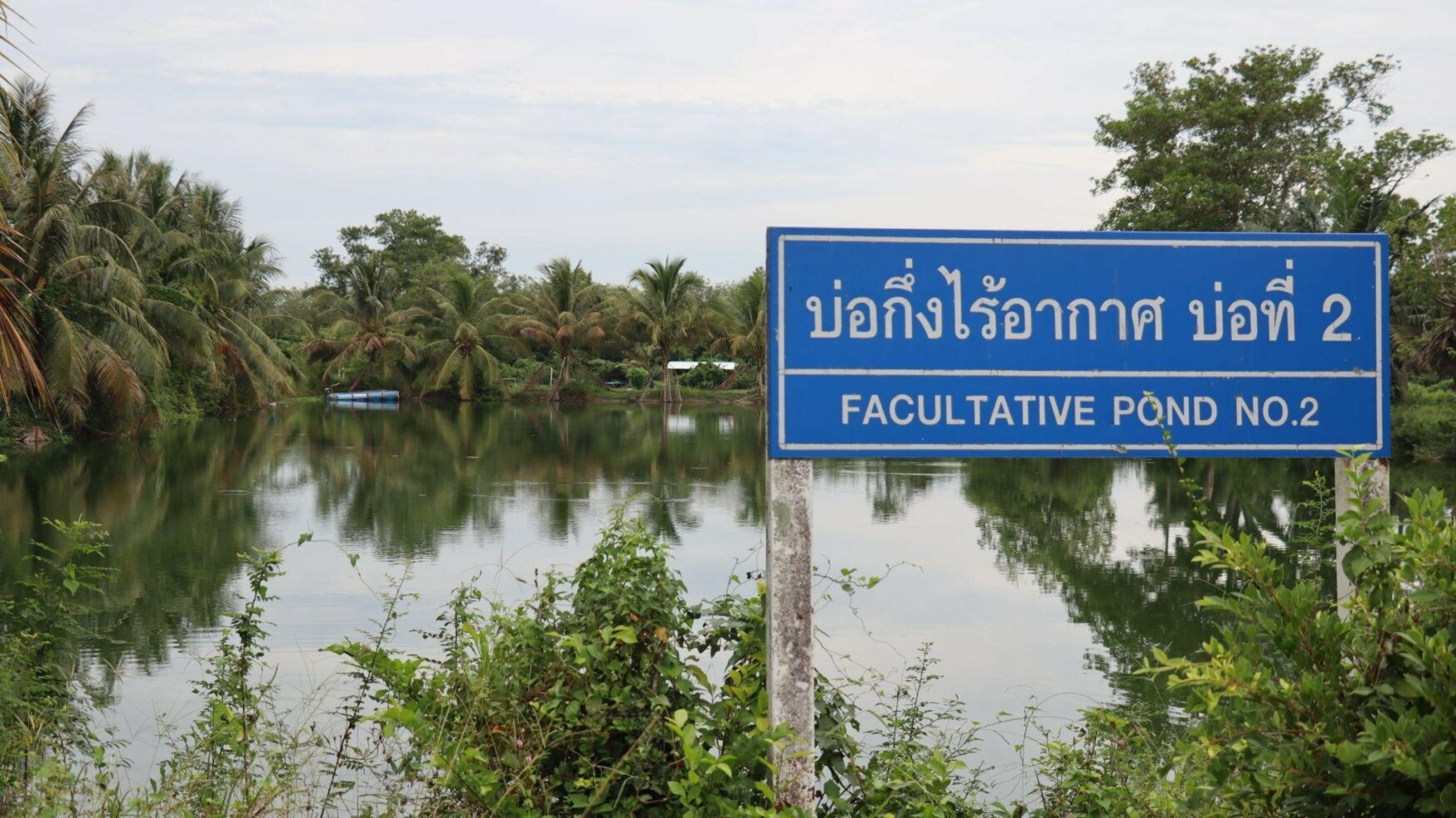
Water then flows into Facultative Pond 2, which is approximately 2 metres deep and has a capacity of 37,752 cubic metres. A retention time of more than seven days allows further sedimentation and decomposition of organic matter before the water proceeds to disinfection and final water quality improvement.
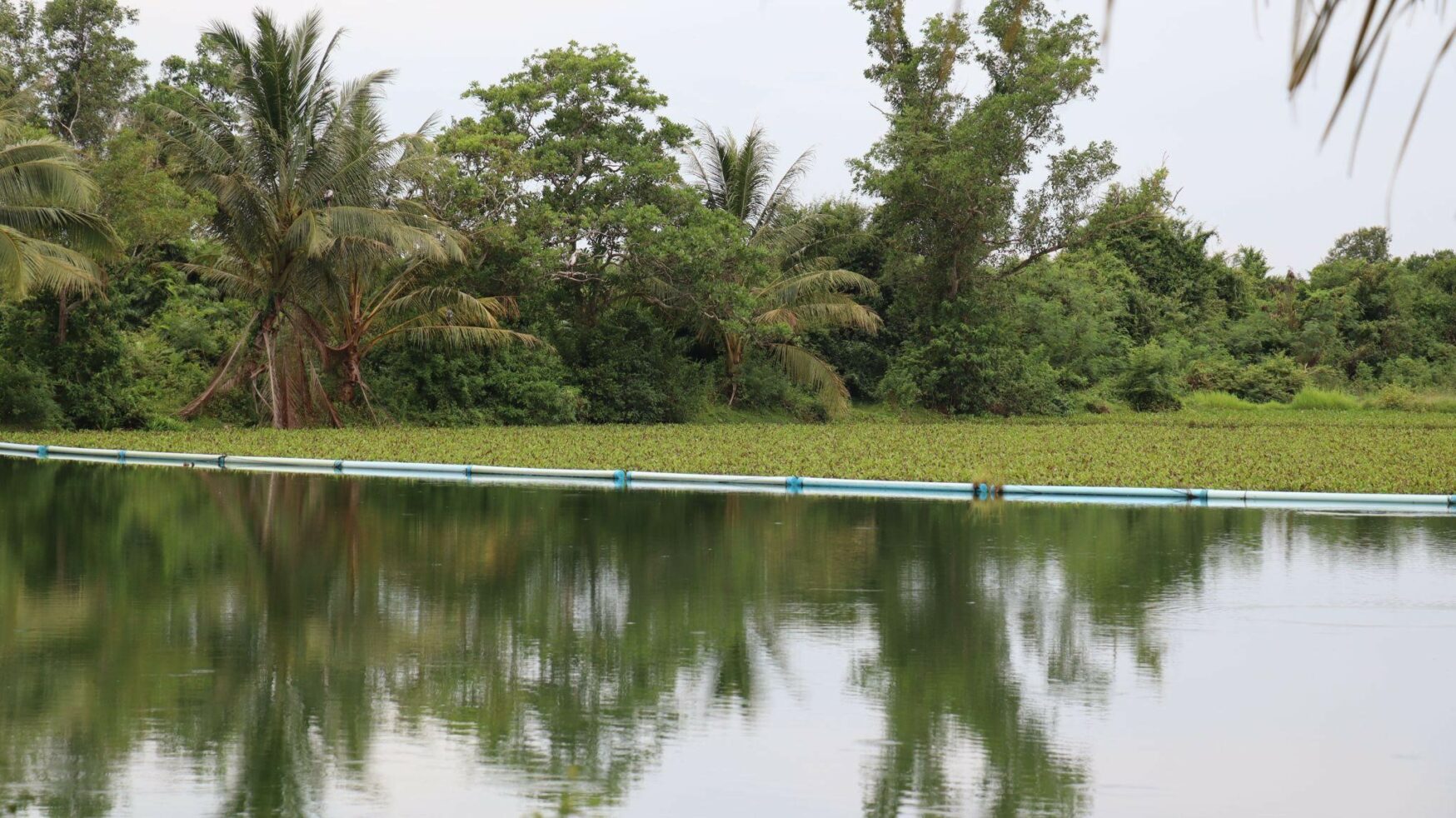
Disinfection and Water Quality Improvement in the Constructed Wetland
Ultraviolet Disinfection
Following biological treatment, the water passes through an ultraviolet (UV) disinfection system operating at a wavelength of approximately 254 nanometres. UV radiation inactivates remaining pathogenic microorganisms, preventing them from multiplying. This process reduces microbial contamination without adding chemical disinfectants to the water. The university regularly maintains the system and replaces UV lamps to sustain its operating efficiency.
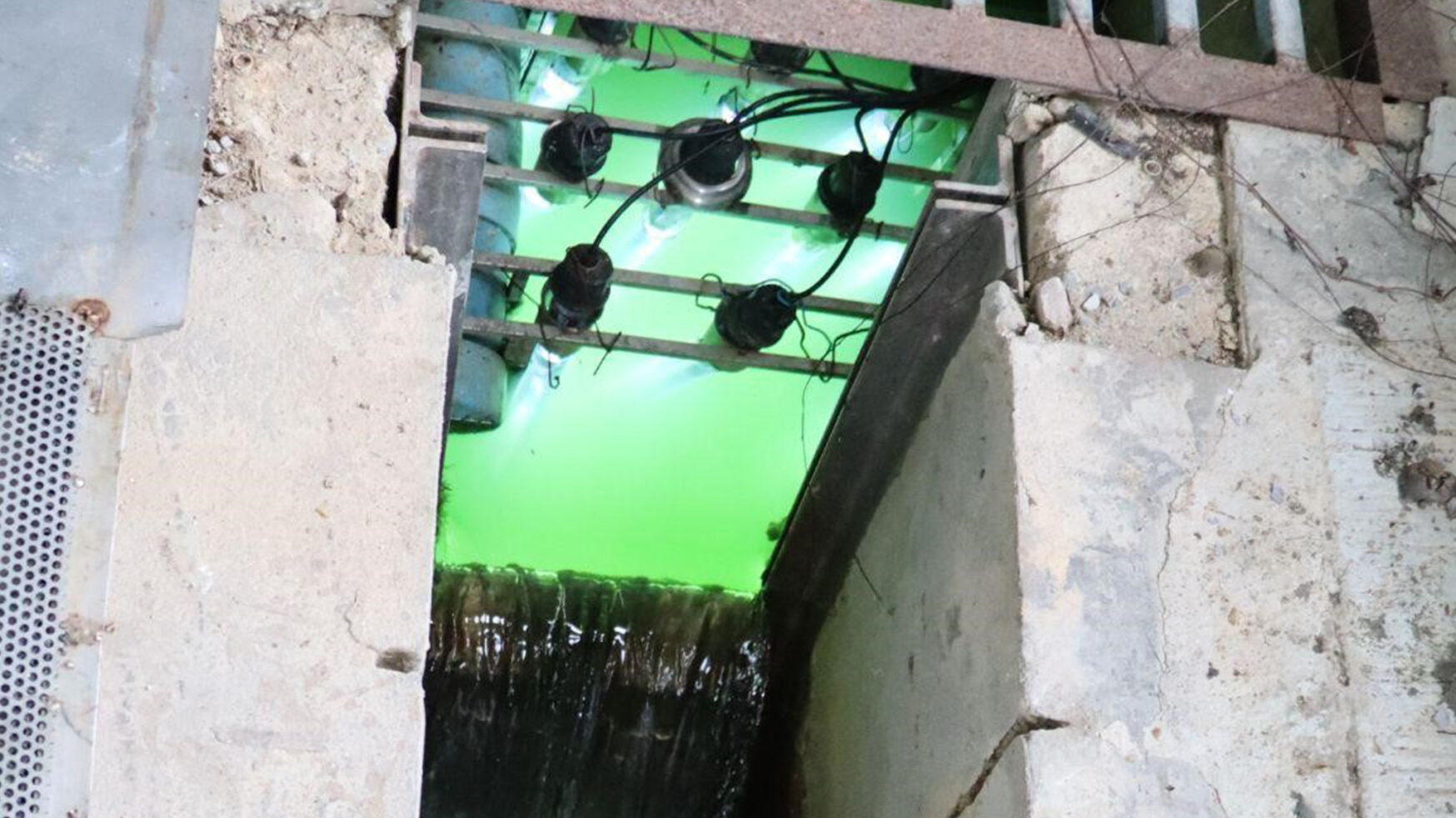
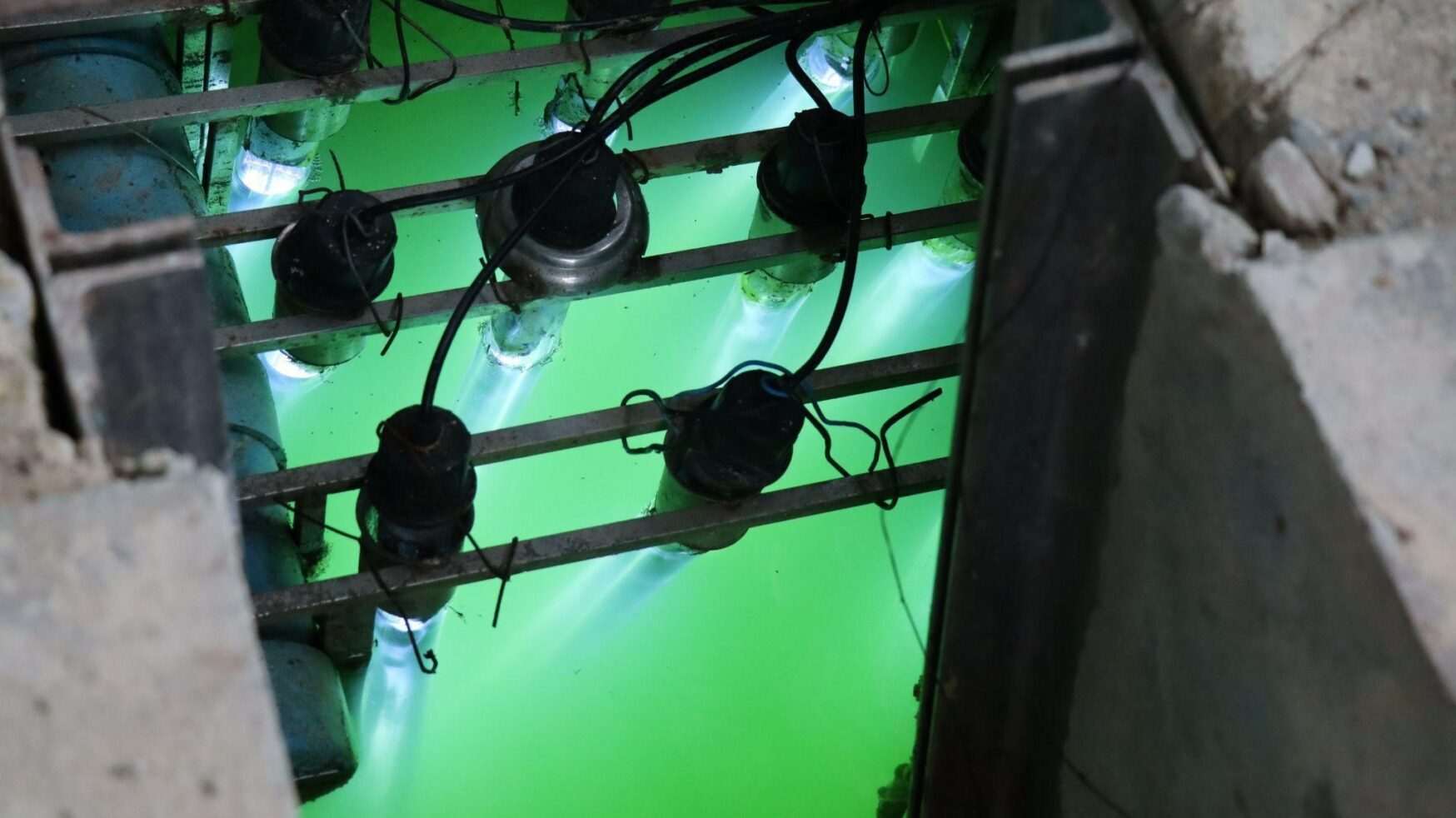
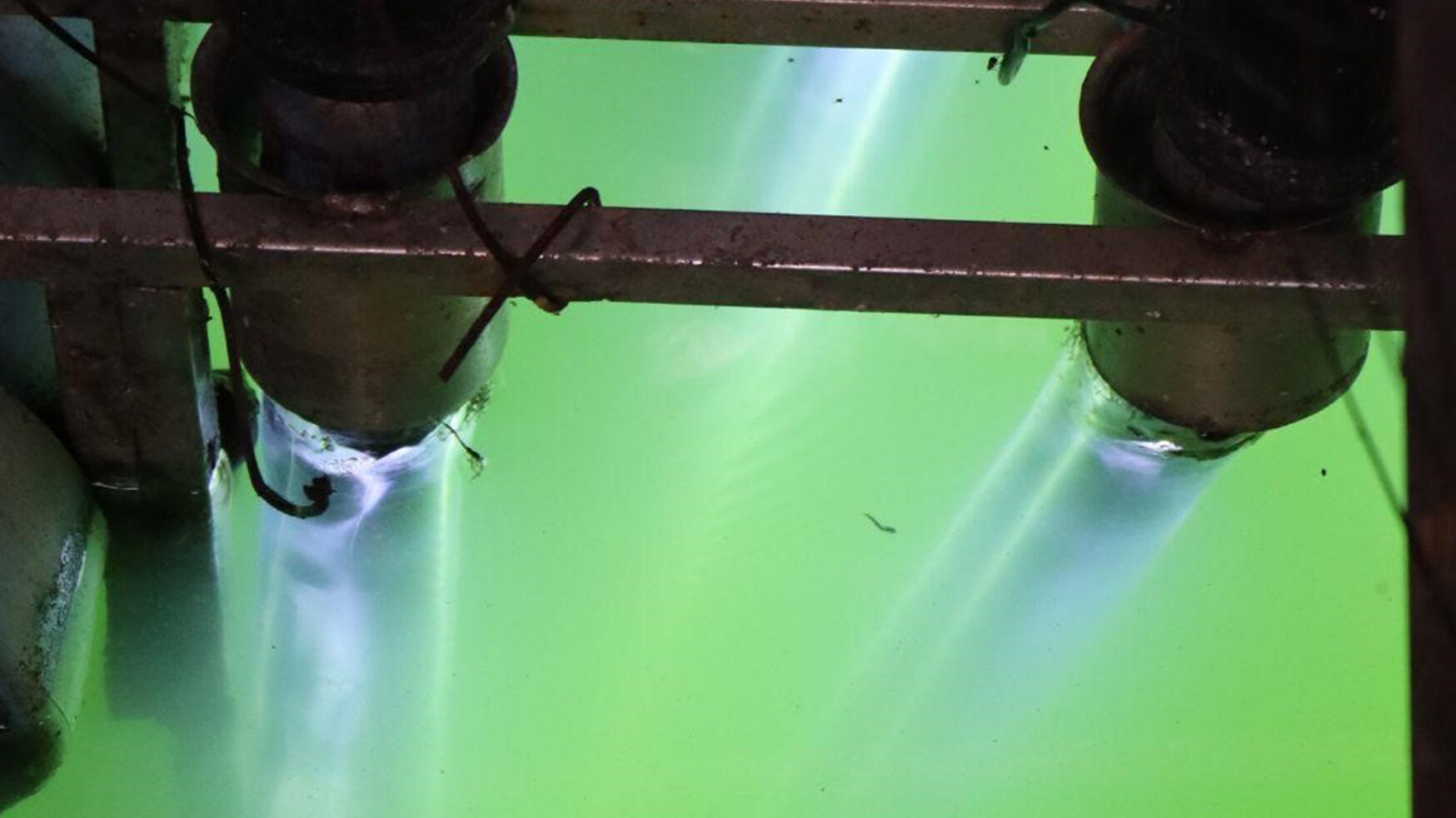
Water Quality Improvement in the Constructed Wetland
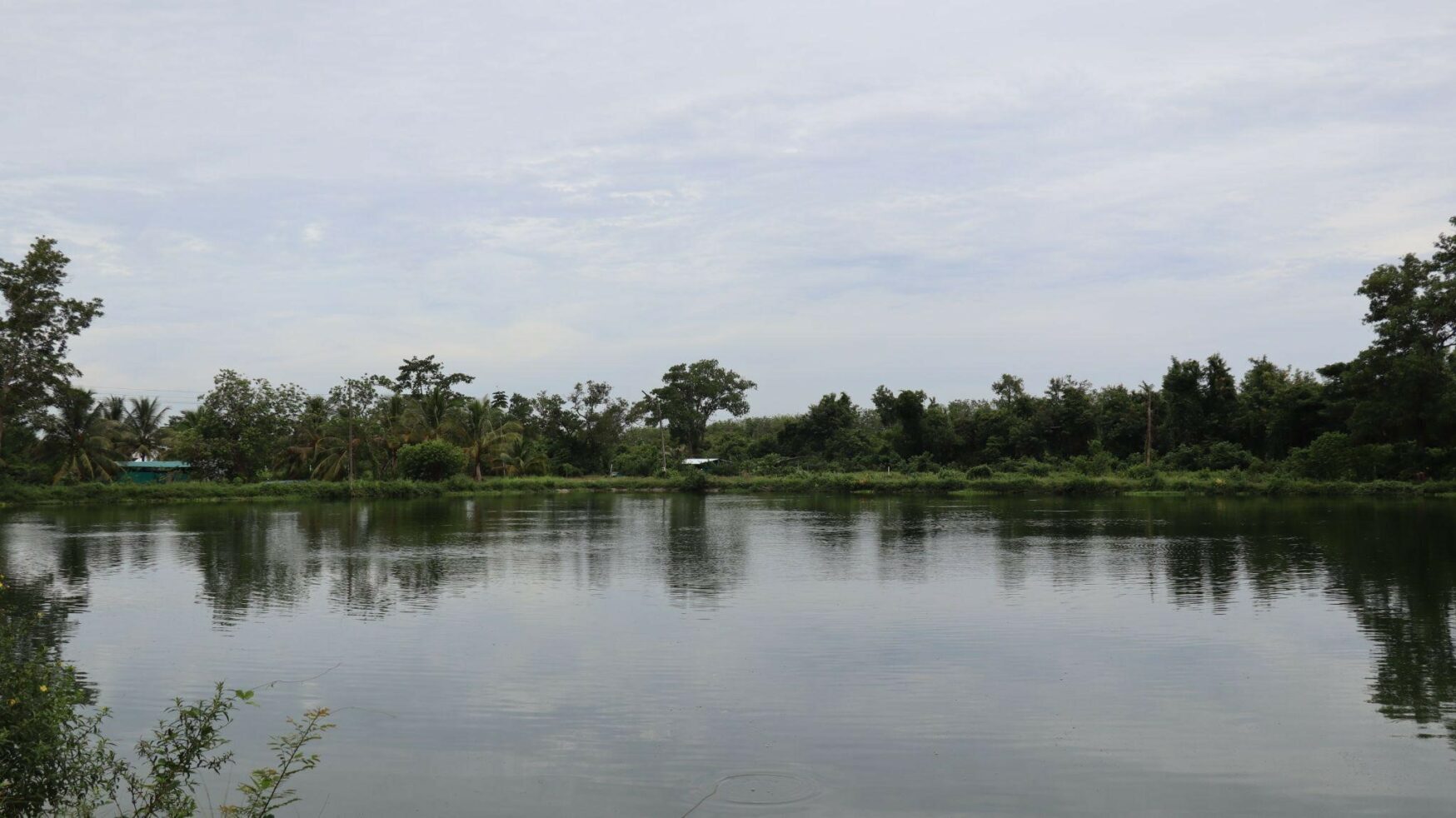
After disinfection, the water flows into a constructed wetland, which provides water storage and further improves water quality through biological processes involving aquatic plants, soil, and microorganisms. The wetland also serves as a learning site for students and researchers studying wastewater treatment and ecosystems.
In 2025, the university introduced microbial powder into the constructed wetland to improve water clarity and reduce ammonia. This provides an additional water quality management measure before treated wastewater is reused or discharged into natural water bodies. The initiative forms part of the university’s ongoing efforts to adapt and improve its wastewater treatment process according to water conditions within the system.
Water Quality Monitoring and Control
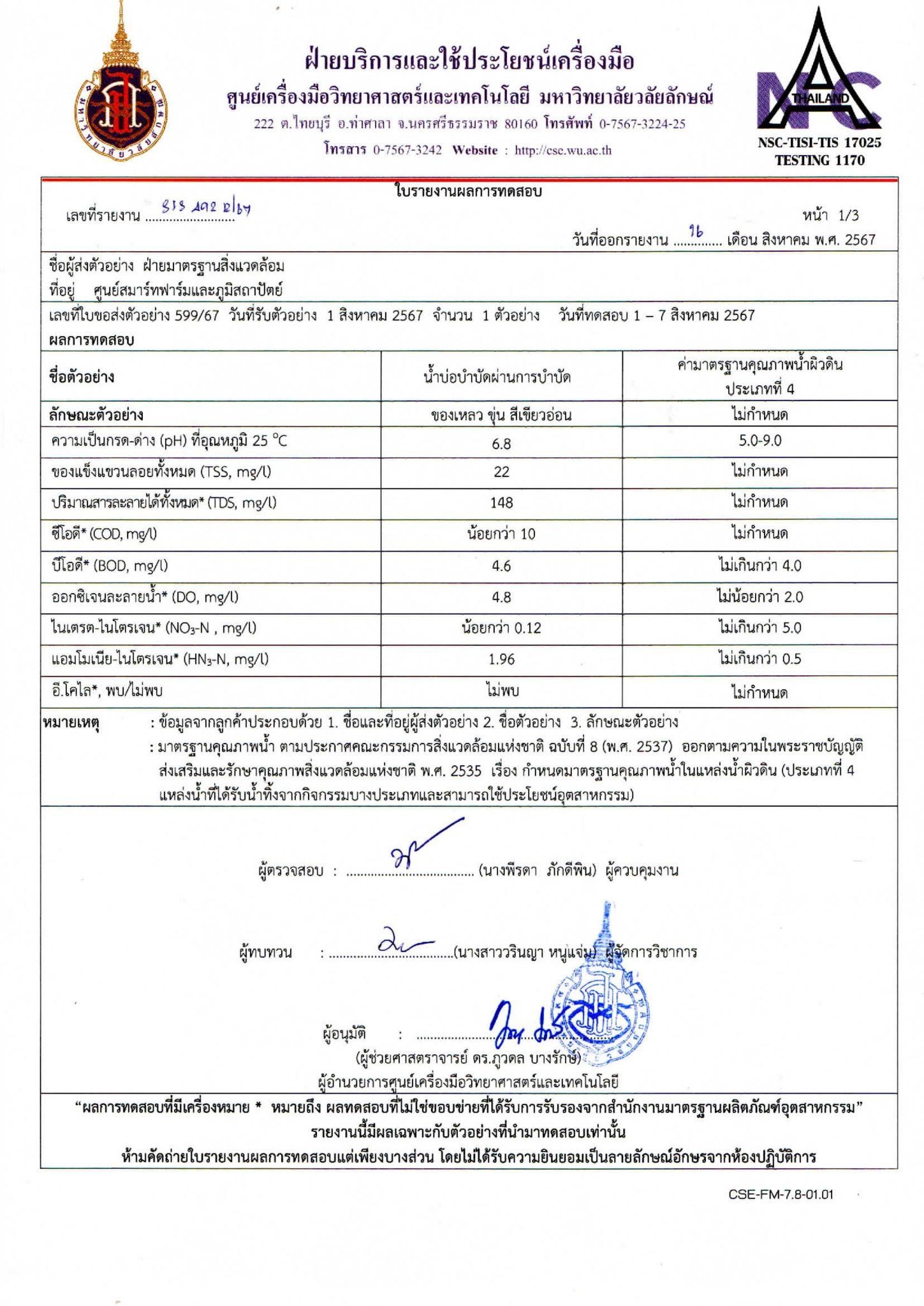
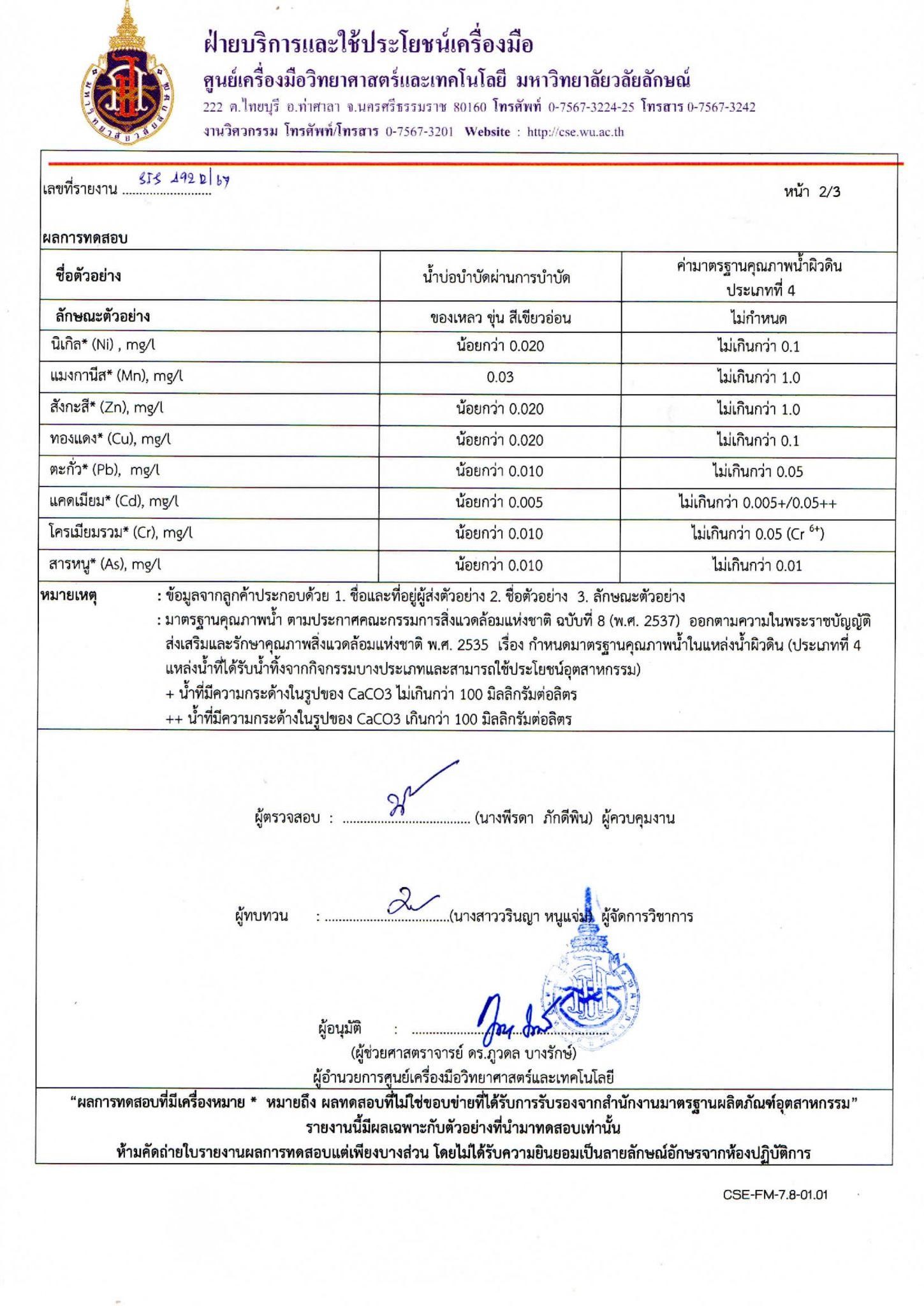
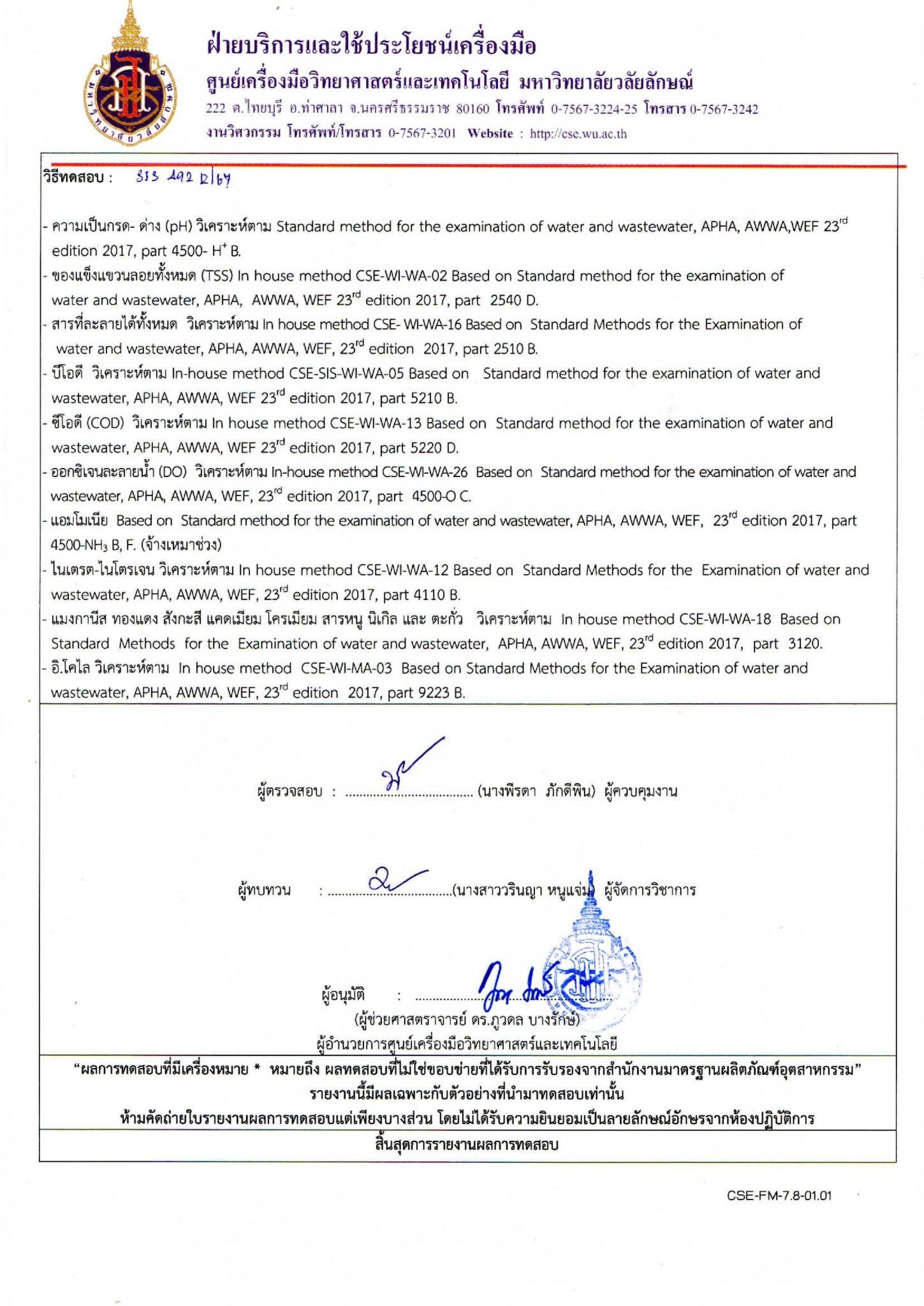
In 2025, Walailak University monitored treated wastewater quality through laboratory analysis. Results were compared against Thailand’s Type 4 surface water quality standards to assess water quality and inform the ongoing management of the wastewater treatment system.
The results showed that pH and dissolved oxygen (DO) met the benchmark criteria in every monitoring round. The pH ranged from 6.8 to 7.1, within the standard range of 5.0–9.0. DO ranged from 4.2 to 5.4 milligrams per litre, exceeding the minimum requirement of 2.0 milligrams per litre. These results indicate consistent pH conditions and dissolved oxygen levels across the reported monitoring rounds.
Heavy metals, including nickel, manganese, zinc, copper, lead, cadmium, total chromium, and arsenic, were below the benchmark limits in every monitoring round. Arsenic was reported at less than 0.01 milligrams per litre, while cadmium was reported at less than 0.005 milligrams per litre, indicating low levels of these substances in the reported laboratory results.
Individual monitoring rounds also recorded compliance with the benchmark criteria for certain parameters. In the first monitoring round in January, BOD was 2.3 milligrams per litre, below the benchmark limit of 4.0 milligrams per litre. In the second monitoring round in June, ammonia nitrogen (NH₃-N) was 0.11 milligrams per litre, below the benchmark limit of 0.5 milligrams per litre, and the water was clear and colourless.
These results support the university’s monitoring and assessment of treated wastewater quality. In 2025, this work was complemented by the introduction of microbial powder into the constructed wetland to improve water clarity and reduce ammonia.
Treated Wastewater Reuse and Biological Water Quality Assessment
Walailak University reuses treated wastewater for activities appropriate to its quality to reduce the consumption of tap water and make efficient use of water resources. The university also uses fish rearing to support biological water quality assessment. These activities include the following:
Watering Trees and Maintaining Green Spaces
The university uses treated wastewater to water trees and maintain campus green spaces. This reduces demand for tap water in landscape maintenance and supports the reuse of water for vegetation care. Its use is selected according to water quality and site characteristics.
Washing Roads and Campus Areas
Treated wastewater is used to wash roads and clean campus areas, removing dust and dirt. This reuse reduces tap water consumption for cleaning activities that do not require drinking-quality water.
Fish Rearing for Biological Water Quality Assessment
The university uses treated wastewater in an experimental Nile tilapia pond to observe fish survival and condition. These observations provide supporting information on whether the water offers suitable conditions for aquatic organisms.
This assessment is conducted alongside laboratory analysis to cover both chemical and biological aspects of water quality. Fish survival provides supporting evidence and is considered together with water quality test results against the relevant criteria.
Cooling Water for the Waste Incinerator
The university uses treated wastewater as cooling water for the waste incinerator to remove heat from components that require water cooling. This reduces tap water consumption and connects water resource use with campus waste management.
Washing Cars and Other Vehicles
Treated wastewater is used to wash cars and other vehicles, removing dirt from their exterior surfaces. Water quality is considered to ensure suitability for the intended use. This reduces tap water consumption for cleaning and increases the beneficial use of treated wastewater.
Water Distribution through Sprinkler Systems
The university distributes treated wastewater through sprinkler systems to irrigate lawns and landscaped areas. These systems distribute water across the designated areas and support green space maintenance. Water quality, sprinkler locations, and operating times are considered to minimise users’ exposure to water spray.
Walailak University’s wastewater treatment process in 2025 therefore covered management at source, biological treatment, disinfection, water quality improvement in the constructed wetland, and water quality monitoring before reuse or discharge. The university also encouraged students and staff to separate waste, reduce grease entering drains, and use water efficiently, supporting the operation of the wastewater treatment system and the continued reduction of environmental impacts.