
03Oct 2024 by Kittipong Bunlear
Walailak University’s Specific Courses on Sustainability
Walailak University recognizes the critical importance of offering specialized courses focused on the Sustainable Development Goals (SDGs) to its students. These SDG-dedicated courses are essential not only for equipping students with the knowledge and skills necessary to address the complex challenges of sustainability but also for fostering a deeper understanding of environmental stewardship and social responsibility. By integrating sustainability into the curriculum, the university aims to prepare students to become proactive change agents in their communities and industries. This initiative reflects Walailak University’s commitment to promoting sustainable practices and ensuring that graduates are well-prepared to contribute positively to a more sustainable future.
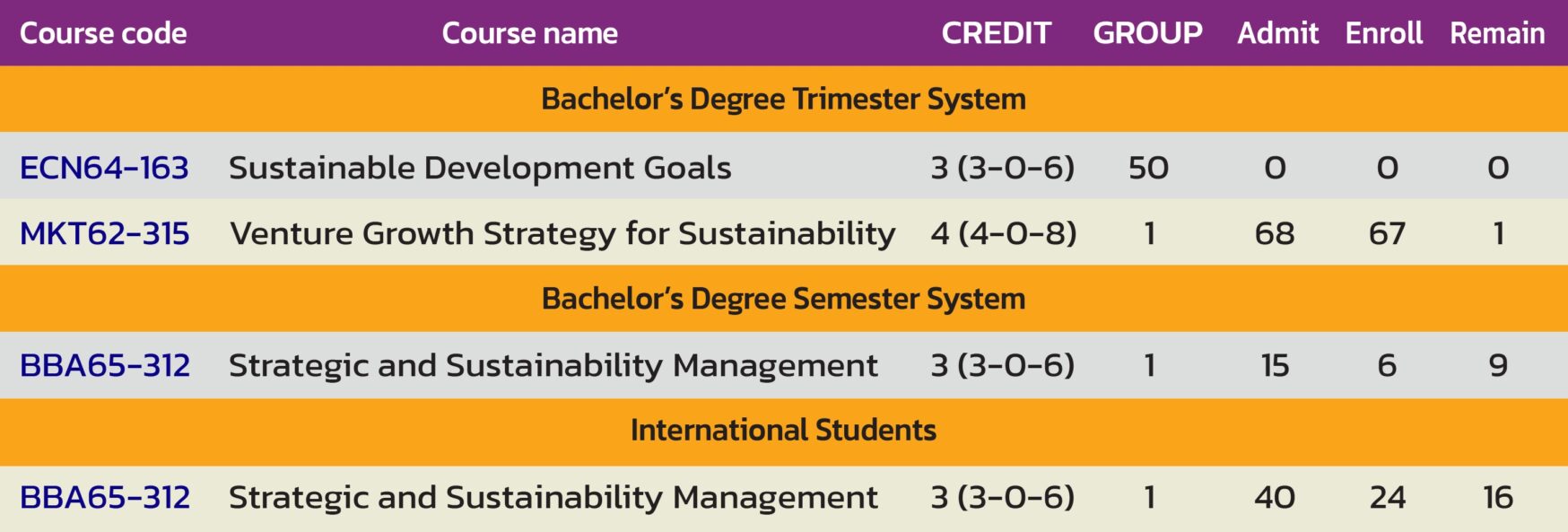
The specific courses on sustainability at Walailak University
- MNM63-613 Sustainability for Business Management (SDG 1, SDG 16 and SDG 8)
Course Description: This subject explores the challenges and opportunities facing entrepreneurships in the area of environmental, socio-cultural and economic for sustainable business management. Introduction of sustainability business will be provided at the beginning. Topics included are sustainable environmental design, sustainable organizational immersion, sustainable value chains and communications for businesses. Various business management approaches from successful entrepreneurs will be employed as the case study so that students can design, plan, and develop projects for sustainable business initiatives.
- BBA65-312 Strategic and Sustainability Management (SDG 1 and SDG 8)
Course Description: This course introduces students to strategies for businesses and business sustainability. It focuses on how firms create, capture, and sustain competitive advantage. The course introduces the students to strategic management models, concepts, and theories. At the end of the course, students should be able to analyze business situations through business environment scanning and formulate strategic plans for business growth and survival. Students will also understand how to implement strategy and organize firms for strategic success. Strategic management business case studies are incorporated throughout the course.
- BMF64-323 Corporate Sustainability Management (SDG 1, SDG 16 and SDG 8)
Course Description: The role of business and society. Key concepts of corporate sustainability management; business ethics, corporate social responsibility, sustainability strategy, social enterprise, sustainable development, corporate governance, sufficiency economy for business operation. Applying these concepts into business strategies and practice. Discussion of critical issues and challenges regarding corporate sustainability management at global and national level for application and competitiveness in the digital era. The role of business and society. Key concepts of corporate sustainability management; business ethics, corporate social responsibility, sustainability strategy, social enterprise, sustainable development, corporate governance, sufficiency economy for business operation. Applying these concepts into business strategies and practice. Discussion of critical issues and challenges regarding corporate sustainability management at global and national level for application and competitiveness in the digital era.
- MKT62-315 Venture Growth Strategy for Sustainability (SDG 16 and SDG 8)
Course Description: This course covers the concepts of sustainable business growth strategy, funding and customer value management for venture growth, and competitive advantage creation. Students have to understand the process of developing business’s skills and competences for sustainable growth, including change management to handle change dynamic of current business environment.
- THM67-122 Tourism Resources Sustainability (SDG 1, SDG 14 and SDG 15)
Course Description: This course aims to enable students to integrate knowledge of the value, impact, and relationship of geography and tourism resources toward sustainable tourism and the hotel industry. In addition, this course aims to enable students to gain teamwork skills through the implementation of a sustainable tourism resource management project and field studies.
- ADA67-524 Sustainable Design (SDG 11, SDG 7 and SDG 13)
Course Description: This course focuses on enabling students to apply sustainable approaches in formulating physical environment design concepts, covering concepts, theories, principles of design to achieve natural resources and environmental balance at present and in the future for the quality of life and all the people.
- ARC59-353 Sustainable Architectural and Urban Design (SDG 11, SDG 7 and SDG 13)
Course Description: Basic concepts of environmental design for different related levels: from city and community to neighborhood and specific sites; study the environmental crisis, as well as lessons from vernacular architecture that were climate responsive and environmentally concerned leading to sustainable architecture and urban design; principles of tropical buildings and urban design which are shaped by nature and influential factors that set the comfort zone.
- ECI65-163 Sustainable Development Goals (SDG 17)
Course Description: This course aims to explain to the students the meaning, components, and case studies of the 17 Sustainable Development Goals. It also provides students with an understanding of the connection between the 20-year National Strategy, the National Economic and Social Development Plan, and the World Sustainable Development Goals.
- ESH61-614 Sustainable Industrial Management (SDG 9)
Course Description: History of industrial development in Thailand, concept of sustainable development and industrial ecology, tools in environmental management system for industry, clean technology, life cycle assessment, economic tools in industrial management, indicator of sustainable development.
- ESH65-625 Occupational and environmental health sustainability (SDG 3, SDG 7, SDG 11, and SDG 13)
Course Description: This course focuses on goals for sustainable development; giving priority to health and environment; smart city indicators: smart environment, smart living, smart people; case studies of occupational and environmental health sustainability.
- ESI60-451 Sufficient Economic for Sustainability (SDG 1, SDG 2, SDG 4 and SDG 13)
Course Description: Ecosystem based adaptation, sufficient economic philosophy and sustainable development; conceptual framework; attribute of sufficiency; economic crisis; application; field visit.
- ESI62-202 Environment and Sustainable Development (SDG 13, SDG 14 and SDG 15)
Course Description: This course emphasizes on Environment and Sustainable Development. Topics include environmental and resource systems; relationship between chemical, physical and biological factors in the environment and human. Topics include environmental problems and pollution effects, resource conservation and environmental management; environmental ethics; problems and solutions associated with environmental ethics; analysis and valuation of the environment based on traditional practice and theory of environmental ethics, sufficiency economy; concepts of sustainable development which take account of local community participation and input in dealing with environmental problems and social conflicts arising from the utilization of natural resources.
- ENH62-411 Sustainable Community Environmental Health Development (SDG 3 and SDG 13)
Course Description: This course focuses on the community health development concepts by applying of holistic paradigm, community-based practices with the application of community health and public places management, development of environmental health professional competencies and participatory environmental health development for health equity.
- ESI62-324 Sustainable Hazardous Waste Management (SDG 6, SDG 12, SDG 13, SDG 14 and SDG 15)
Course Description: This course emphasizes on Sustainable Hazardous Waste Management. Topics include situation and effects of hazardous, principal of hazardous protection and control, clean production, law and agreements related to hazardous management and control, sampling and analysis of hazardous in surface water, underground water, soil and air, and quality control and data quality of hazardous analysis.
- LND60-541 Sustainable Landscape Architectural Design (SDG 7, SGD 11 and SDG 13)
Course Description: Basic concepts of environmental design for different related levels: from city and community to neighborhood and specific sites; study the environmental crisis, as well as lessons from vernacular landscape architecture that were climate responsive and environmentally concerned leading to sustainable design including urban design; principles of tropical design, site planning and urban design which are shaped by nature and influential factors that set the comfort zone.
- MNG61-631 Sustainable Tourism Management (SDG 13, SDG 14 and SDG 15)
Course Description: This course provides students about the concepts and principles of sustainable tourism, regulations, planning and monitoring of sustainable tourism management in the tourism and hotel business. This course also covers components and types of sustainable tourism, tourism impact, and sustainable tourism development strategies, including analysis and discussion from case studies.
- MRS62-354 Sustainable Utilization, Conservation and Restoration of Marine and Coastal Resources (SDG 14 and SDG 15)
Course Description: Concepts and characteristics of biodiversity, marine and coastal ecosystem services: values and importance; marine species (mammals & others): rare and extinction issues; importance of preservation for pristine natural environment; impacts from anthropogenic activities, climate changes and natural causes; assessment of vulnerability to marine and coastal ecosystems, resources and environments; concepts and applications of sustainable utilization and conservation; Ecosystem-based Adaptation (EbA) and local wisdoms; principles and types of conservation, restoration and others activities; practical and effective examples from local and abroad. Tools and technologies for research and monitoring on marine and coastal resources.
- OCC62-183 Sustainable development activities (SDG 16 and SDG 17)
Course Description: This course provides principle of sustainable development Corporative social responsibility; critical element of corporative social responsibility initiative; social engagement strategies; corporate ethics; global sustainability and reporting initiative; millennium development goal; case studies and field trips issues on corporative social responsibility.
- PCA67-112 Sustainable Food Systems (SDG 2, SDG 12, SDG 14 and SDG 15)
Course Description: This course focused on the understanding the connections between the kitchen and the rest of the world. This course will provide the tools students needed to select and source high quality, sustainable ingredients, and inspire them to explore and understand our food system. The focus will be on contemporary methods of food production, distribution, processing, marketing, purchasing, preparation, and waste management. These components will be examined from an environmental perspective with the objective of understanding the resource-intensive nature of the current food system and its impact on social, economic, and environmental sustainability. Particular emphasis will be placed on the contributions of restaurants to the climate crisis and their potential role in ameliorating its causes. It is hoped that through the experience of this course, students will contribute to food sustainability by practicing the responsible sourcing of ingredients.
- SCC67-326 Green Chemistry and Sustainable Development (SDG 6, SDG 9, SDG 12, SDG 13, SDG 14 and SDG 15)
Course Description: This course is intended to provide students with a comprehensive overview of the principles and applications of green chemistry and sustainable development. Students study innovative strategies and methodologies designed to minimize the environmental impact of chemical processes and products, and promoting the long-term well-being of society and the planet. Students gain a deep understanding of the impact of green chemistry on sustainable development goals through a combination of theoretical knowledge, practical examples, case studies, and interactive discussions. Students present works, complete assignments without plagiarism, and adhere to the agreements of this course.
- SOE66-381 Education for Sustainable Development (SDG 4)
Course Description: This course is designed for students to study education for sustainable development. The topics of this course consist of definition and components of education for sustainable development, sustainable development goals (SDG Goals), roles of education and educational institutions in Thailand, development education for all, concepts of education management for sustainable development, educational management model for sustainable development, educational management for sustainable development, trends of educational management in the 21st century, educational reform for sustainable development, and applying the knowledge for the management of social studies learning.
Related links:

Post Views: 131