3R (Reduce, Reuse and Recycle) Program for University Waste (WS1)
3 R Programs in Walailak University

3R Waste Management Practices at the University.
All of the following 3R programs are active programs and 100% are fully implemented.
1) Food waste from the cafeteria is reduced by using food scraps as animal feed.
The university has a farm where pigs are raised, and organic waste is used as animal feed. This initiative reduces waste and lowers the cost of animal feed production.
2) Composting.
The university has established a unit or project to promote composting by converting collected organic waste into compost for use in university gardens and plots. The compost is produced by composting leaves, twigs, and grass clippings to nourish campus trees. This initiative aims to address the high cost of commercial fertilizers and add value to organic materials generated from pruning, mowing, and leaf cleaning. The composting process is based on research and the formulation of compost recipes to ensure quality. The resulting compost undergoes quality testing to meet compost standards before use.
3) Conduct a practical workshop on 3R (Reuse, Reduce, Recycle) Plastic for students and staff.
Walailak University’s commitment to raising student awareness is encapsulated in the course “GEN64-142: Environmental Conservation and Global Warming,” This course provides a conceptual framework, principles, processes and rationales for sustainable environmental conservation and quality living. Students study activities for environmental protection through the use of environmentally friendly processes in energy and water consumption, waste management as well as correct practices of waste separation, and transportation management. Topics include the examination of global warming’s causes and effects and the roles of international organizations and politics in solving global warming problems.
Walailak Go Green University consistently organizes green university activities and projects each year, all contributing to attaining SDG goals 3, 12, 14, 15, and 17. These encompass health and well-being, sustainable consumption and production, ocean and land ecosystem conservation, and global cooperation for sustainable development. It also Promoter waste reduction through various activities based on the 3R principles.
Establishing a student club focused on environmental conservation and organizing campaigns promoting the 3Rs of waste management.
4) A plastic reduction campaign is encouraging staff and students to bring reusable bags and personal water bottles to reduce single-use plastic packaging.
This project encourages staff and students to use reusable bags and personal water bottles to reduce single-use plastic waste, a major contributor to plastic pollution. It aligns with the university’s green initiative, aiming to conserve the environment and promote sustainability by decreasing plastic waste on campus.
5) Water dispensers have been installed to decrease the use of plastic water bottles.
This project aims to reduce the use of plastic water bottles by providing clean drinking water dispensers for staff, students, and visitors across the university. This initiative ensures convenient and safe access to clean drinking water, reducing reliance on single-use plastic bottles.
6) Repurpose clean plastic bottles as containers for dish soap or hand soap.
This project primarily aims to reduce plastic waste by repurposing clean plastic bottles as containers for dish soap or hand soap.
7) The campaign promotes the use of both sides of paper to conserve resources.
This project aims to reduce paper consumption by encouraging staff and students to use both sides of paper. This initiative will significantly decrease the amount of paper used on campus.
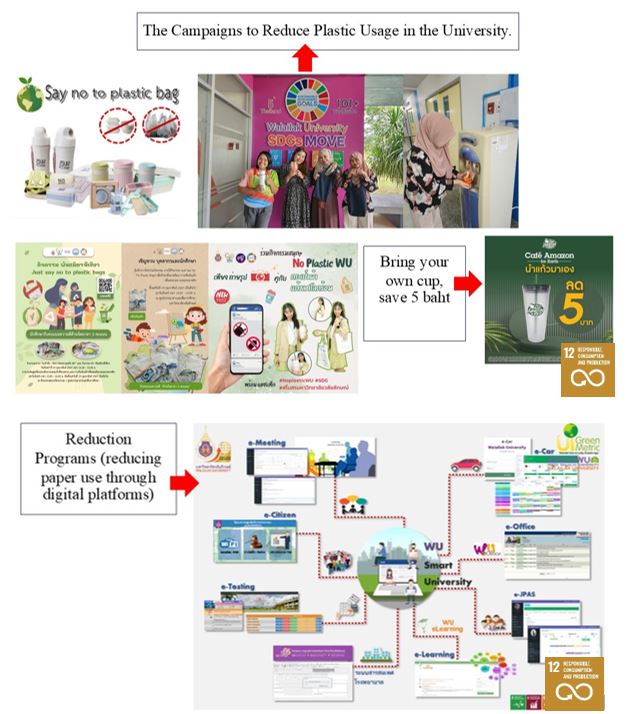
Example of Reduce for University Waste (Walailak University, Thailand)

Example of Reuse for University Waste (Walailak University, Thailand)

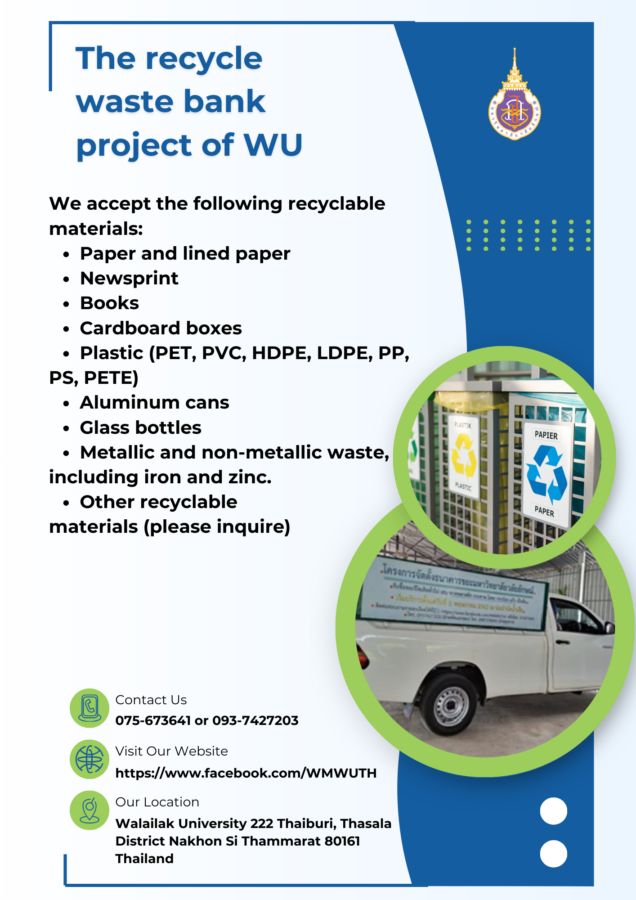
Example of Recycle for University Waste (Walailak University, Thailand)