Tracking Access Measures of Women Students’ Application and Acceptance Rates at Walailak University  

Tracking Access Measures of Women Students’ Application and Acceptance Rates at Walailak University  

The Center for Educational Services (CES), led by Dr. Neeranat Kaewprasert Rakangthong, is the primary organization at Walailak University responsible for systematically tracking and measuring women’s application and acceptance rates. This initiative plays a crucial role in advancing gender balance among the university’s students, reflecting Walailak University’s commitment to promoting gender equality.
According to reports from the Center for Educational Services, more than 14,000 students across Thailand applied to Walailak University for the academic year 2023, of which 72% were women students. The acceptance rate for the academic year 2023 was 3,504, of which more than 2,000 were female students. This indicated that women students were still the majority among students at Walailak University. However, it is still necessary to track the application and acceptance rates of female students to show the university’s commitment to gender diversity promotion.

Figure: A group of female high school students applying to Walailak University in the School of Allied Health Sciences.

The CES has developed a website systematically collecting all the statistical data on SDG 2, SDG 3, SDG 4, and SDG 5, and other relevant statistical data. This website has been developed to show that Walailak University has placed importance on promoting gender diversity and inclusion as the website can provide information to the CES to identify and monitor trends and barriers that may deter women students from applying and participating in higher education. The website shows the number of women students each year and keeps updating the number of women students who have quit or participated at Walailak University. The website can be reached at https://ces.wu.ac.th/registrar/refer/sdg2.asp
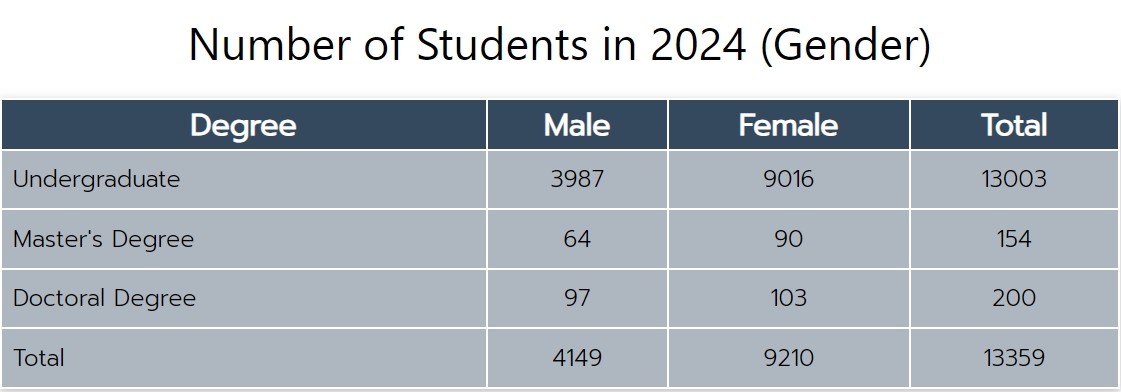
Figure: The table showing the number of women students’ acceptance rate compared to male students in the website.

Besides, the Center for Educational Services has developed another website that provides more details about the number of female and male students in each of their program affiliations. The details are useful to the CES staff, who are responsible for tracking the acceptance rate of female students. The website can be reached at https://ces.wu.ac.th/registrar/student_total2.asp
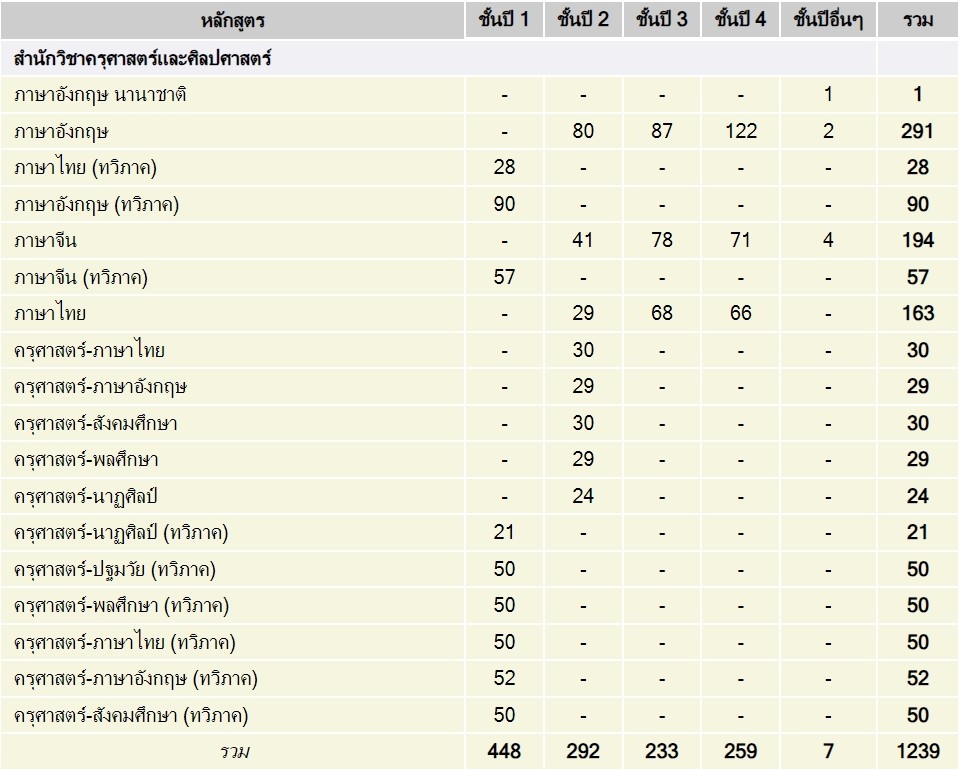
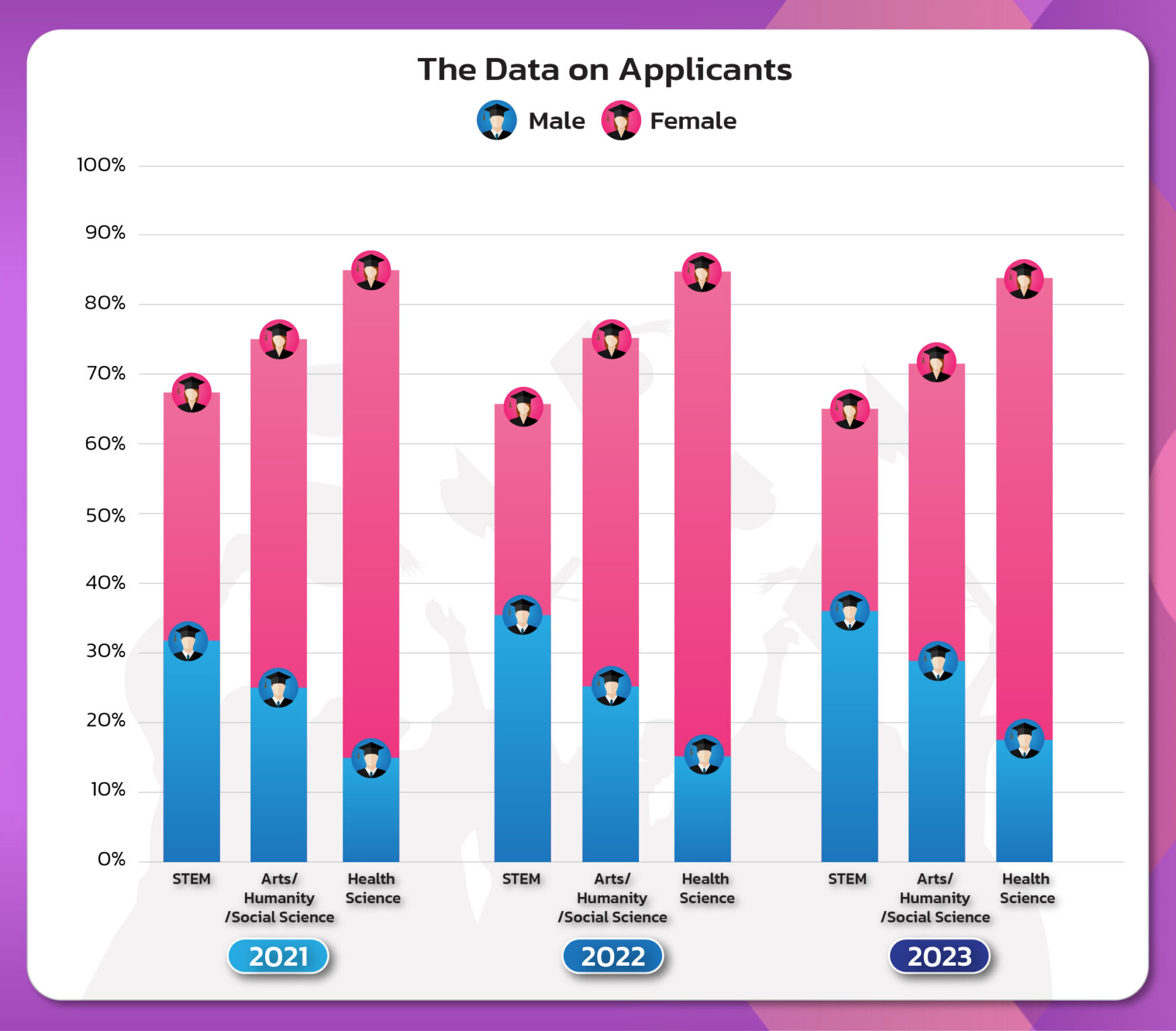
Figure: The table showing the information about the number of current FTE students, both women and men, whose major is liberal arts and education.
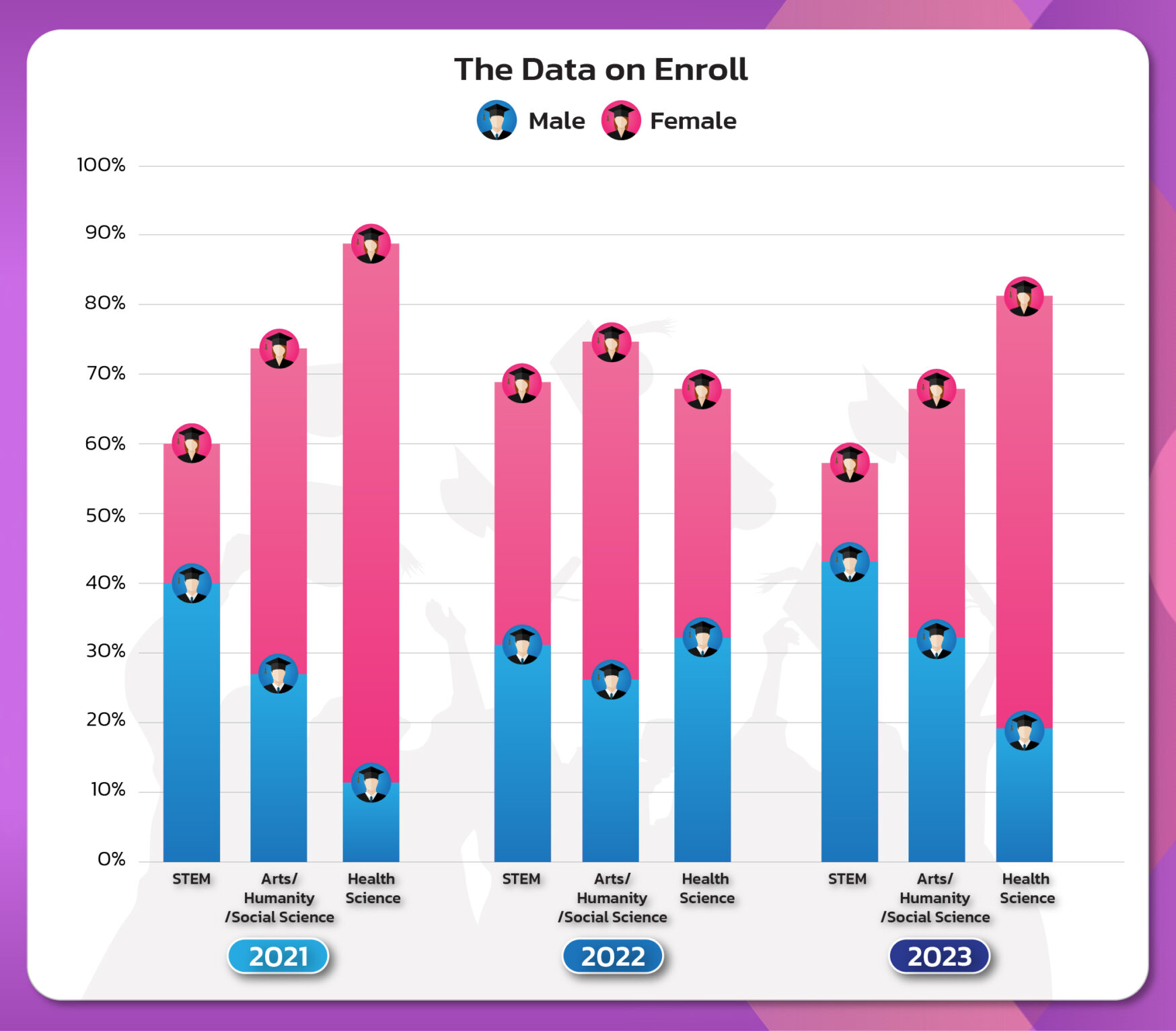
WU continually and systematically measured the number of students both male and female in every School. Exquisitely, the university divided the numbers into the subsequences of academic years to clearly depict the variant number of applicants, enrolled students, and graduates as shown in the form of bar graphs below:
The increased number of female students shows WU’s commitment to prioritizing women as much as men. Providing opportunities to all is what labels the title of Walailak University in the fabric of the globe. Besides, the measured rates below show growing number of women in the university.

Female Enrollment Rate Comparing to Male Enrollment (%)

2021:

      • Male Applicant Percentage: 17.49%
      • Female Applicant Percentage: 82.51%

2022:

      • Male Applicant Percentage: 18.72%
      • Female Applicant Percentage: 81.28%

2023:

      • Male Applicant Percentage: 18.94%
      • Female Applicant Percentage: 81.06%

Female Enrollment Rate Comparing to Male Enrollment (%)

      • 2021: 69.99%
      • 2022: 45.58%
      • 2023: 69.86%
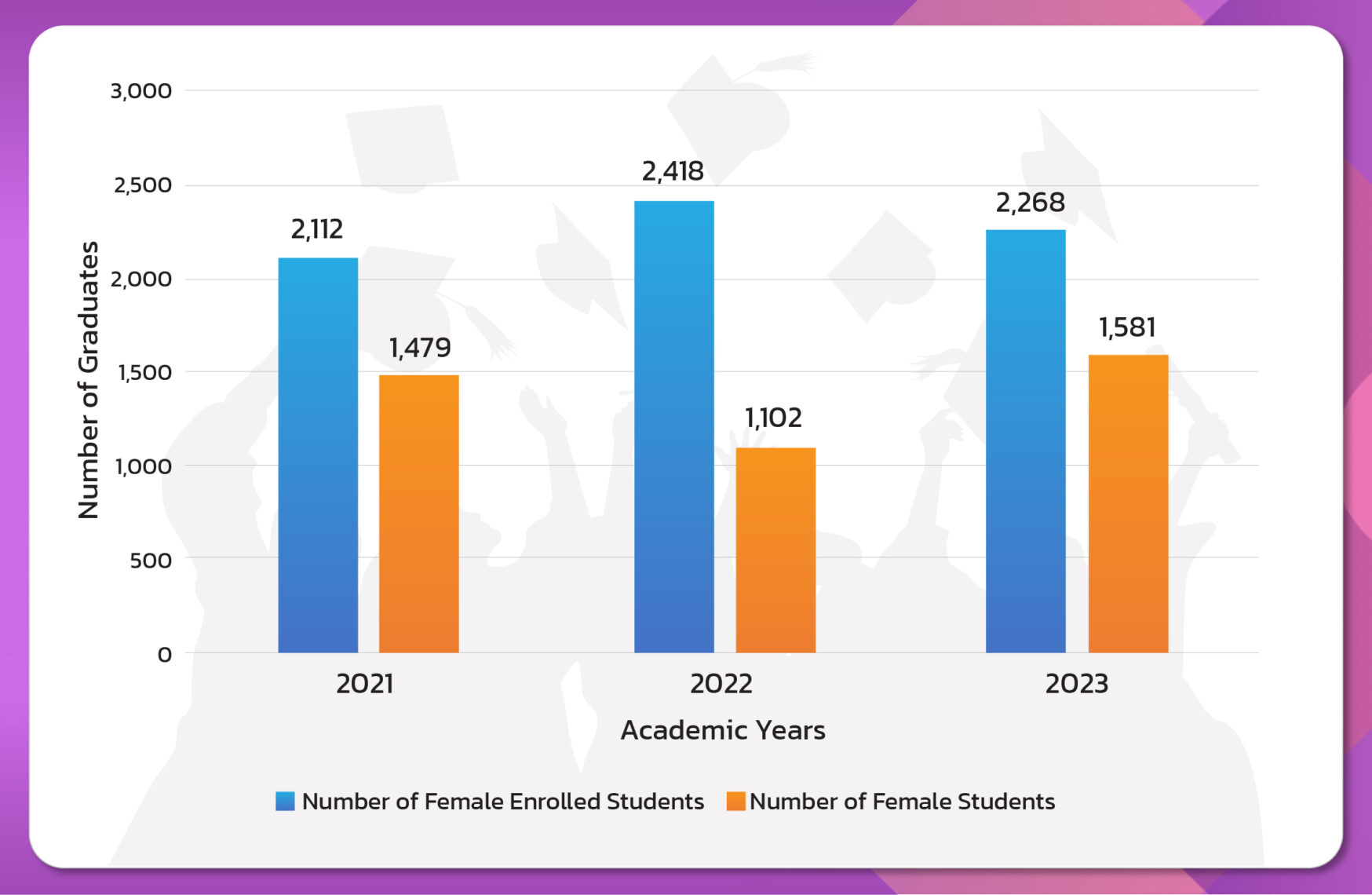
The female applicants consistently make up over 80% of the total applicant pool from 2021 to 2023, with percentages of 82.51% in 2021, 81.28% in 2022, and 81.06% in 2023. This strong female representation underscores Walailak University’s appeal to women students and highlights the institution’s supportive environment for female applicants. In terms of graduation outcomes, female graduation rates compared to enrollment showed a slight fluctuation, with rates of 69.99% in 2021, a dip to 45.58% in 2022, and a recovery to 69.86% in 2023.
To clarify outcomes of the tracking, the number of female applicants over the years is as illustrated below:

Figure: The number of female enrolled students and graduates in the academic year 2021-2023.

By continually measuring and analyzing student numbers in each academic year and across each school, Walailak University demonstrates a clear commitment to gender inclusivity. The increased number of female students over recent years illustrates WU’s proactive approach to providing equal opportunities for women. This dedication to inclusivity and opportunity solidifies Walailak University’s standing as a leader in promoting gender diversity in higher education, contributing to a balanced and inclusive global academic community.

Goal 5: Gender Equality

Goal 10: Reduced Inequalities