Planning, implementation, monitoring and/or evaluation of university governance through the utilization of Information and Communication Technology (ICT)
Planning, implementation, monitoring, and/or evaluation of university governance through the utilization of Information and Communication Technology (ICT)
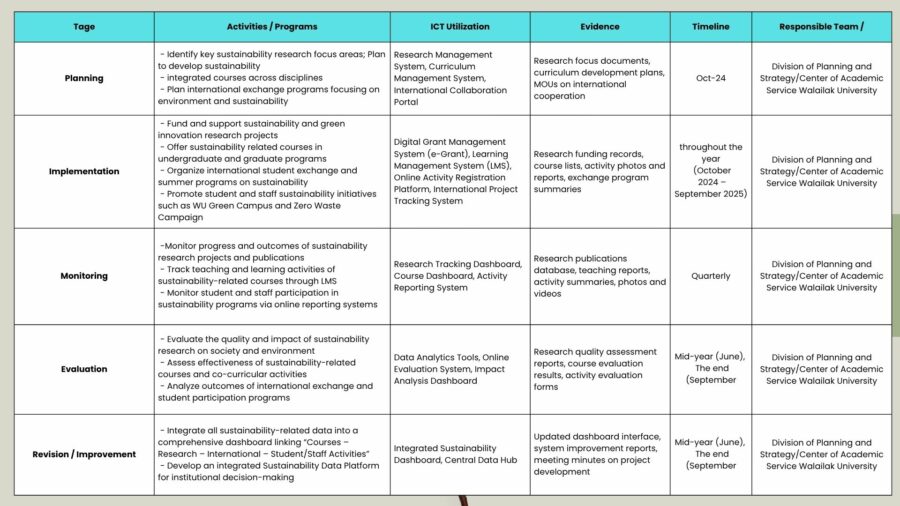
Description of Planning, Implementation, Monitoring, and Evaluation of University Governance through ICT
Walailak University has systematically integrated Information and Communication Technology (ICT) into its governance to enhance the management of education, research, international collaborations, and sustainability-related activities. The process is structured into five stages: Planning, Implementation, Monitoring, Evaluation, and Revision/Improvement.
- Planning Stage
During the planning stage, the university identifies key sustainability research areas to guide its future research agenda. Simultaneously, it plans the development of sustainability-integrated courses across various disciplines to ensure students gain knowledge and skills aligned with the United Nations Sustainable Development Goals (SDGs). Additionally, the university designs international exchange programs focusing on environmental sustainability to promote global engagement and cross-cultural learning. ICT tools such as the Research Management System, Curriculum Management System, and International Collaboration Portal are utilized to support planning and documentation. Evidence of this stage includes research focus documents, curriculum development plans, and Memoranda of Understanding (MOUs) with international partners. This stage was conducted between January 2024 and March 2024, under the coordination of the Research Office, Academic Affairs Office, ICT Department, and the Center for International Affairs.
- Implementation Stage
In the implementation stage, Walailak University actively supports sustainability research and green innovation projects by providing funding and resources. Sustainability-related courses are offered at undergraduate and graduate levels, while international student exchange programs and summer camps promote experiential learning on global sustainability issues. Documentation includes research funding records, course offerings, activity reports, photographs, and summaries of international exchange programs.
- Monitoring Stage
The university continuously monitors the progress of sustainability research projects, publications, teaching activities in sustainability courses, and participation in student and staff sustainability initiatives. Monitoring is facilitated through research tracking dashboards, course dashboards, and online activity reporting systems, allowing real-time data collection and oversight. Evidence for this stage includes research publication databases, teaching reports, activity summaries, and multimedia records of campus events. Monitoring is an ongoing process, managed by the Research Office, ICT Department, and Student Affairs Division.
- Evaluation Stage
Evaluation focuses on assessing the quality and impact of sustainability research, the effectiveness of sustainability courses, and the outcomes of international exchanges and student/staff engagement programs. ICT tools such as data analytics platforms, online evaluation systems, and impact analysis dashboards are utilized to collect and analyze data efficiently. Results are documented in research quality assessment reports, course evaluation outcomes, and activity evaluation forms. Evaluation occurs on an annual basis and is coordinated by the Research Office, Academic Affairs Office, and ICT Department.
- Revision and Improvement Stage
Finally, the university is actively improving its ICT integration by developing an integrated Sustainability Data Platform. This platform consolidates information across courses, research, international collaborations, and student/staff sustainability initiatives into a comprehensive dashboard, facilitating strategic decision-making and continuous improvement. Evidence includes updated dashboard interfaces, system improvement reports, and meeting minutes regarding project development. This stage is ongoing from 2025 onward, led by the ICT Department in collaboration with the Research Office, Academic Affairs Office, and Student Affairs Division.
Overall Implementation Level
Walailak University has fully implemented, evaluated, and continues to revise its ICT-based governance program (Level 5). The systematic use of ICT supports education, research, international activities, and sustainability initiatives at all stages, ensuring effective planning, execution, monitoring, and continuous improvement.