
Advancing Sustainability Education through Dedicated University Courses
Advancing Sustainability Education through Dedicated University Courses
Sustainable development requires graduates to understand complex global challenges, diagnose sustainability issues, and apply their knowledge to develop effective solutions. Higher education institutions therefore play an important role in equipping students with the knowledge, skills, and critical thinking needed to advance the United Nations Sustainable Development Goals (SDGs). Integrating sustainability into dedicated courses and university curricula enables students to examine environmental, social, and economic challenges, conduct diagnostic assessments of existing conditions, and identify practical approaches to sustainable development. Walailak University recognizes the importance of sustainability education in preparing graduates to respond to emerging challenges and contribute meaningfully to the achievement of the SDGs.
Integrating Sustainability and the SDGs into University Courses
Sustainable development requires graduates to understand complex global challenges, diagnose sustainability issues, and apply their knowledge to develop effective solutions. Higher education institutions therefore play an important role in equipping students with the knowledge, skills, and critical thinking needed to advance the United Nations Sustainable Development Goals (SDGs). Integrating sustainability into dedicated courses and university curricula enables students to examine environmental, social, and economic challenges, conduct diagnostic analyses of existing conditions, and identify practical approaches to sustainable development. Walailak University recognizes the importance of sustainability education in preparing graduates to respond to emerging challenges and contribute meaningfully to the achievement of the SDGs.
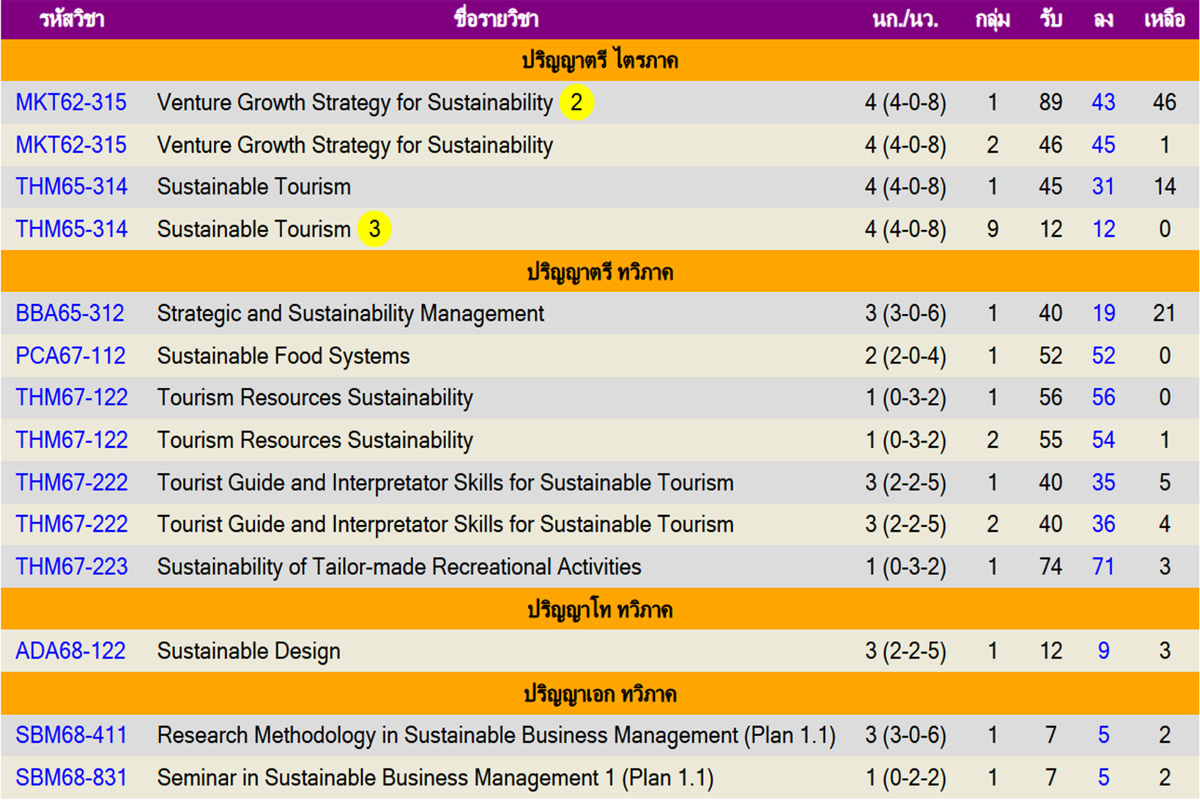
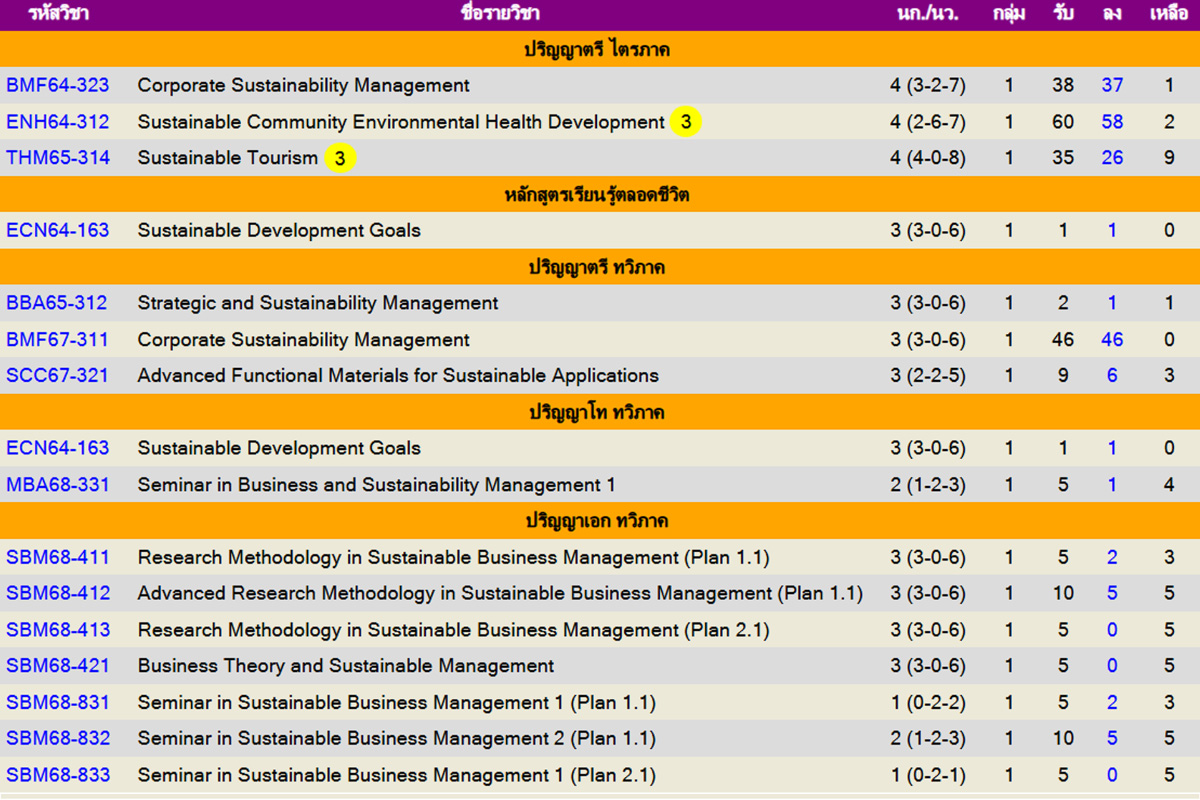
In 2025, Walailak University offered 19 courses dedicated to sustainability and the SDGs across business administration, tourism, food systems, environmental health, design, materials science, and other areas of study. These courses demonstrate the university’s commitment to embedding sustainability principles into diverse academic disciplines and providing students with opportunities to develop specialized knowledge and practical competencies relevant to sustainable development. The courses address topics ranging from sustainable business strategies and responsible resource management to sustainable tourism, environmental protection, and the implementation of the SDGs.
Sustainability and the SDGs Across Academic Disciplines
The university’s sustainability-related courses address a broad range of themes, allowing students to explore the application of sustainability principles in different professional and academic contexts.
1.Sustainable Business, Management, and Entrepreneurship
Walailak University offers courses that examine how organizations can integrate sustainability into business strategies, management practices, and long-term development. These include:
- MKT62-315 Venture Growth Strategy for Sustainability
- BBA65-312 Strategic and Sustainability Management
- BMF64-323 Corporate Sustainability Management
- MBA68-331 Seminar in Business and Sustainability Management 1
- SBM68-421 Business Theory and Sustainable Management
- SBM68-832 Seminar in Sustainable Business Management 2 (Plan 1.1)
- SBM68-833 Seminar in Sustainable Business Management 1 (Plan 2.1)
These courses introduce students to sustainable business growth, strategic planning, competitive advantage, corporate social responsibility, business ethics, corporate governance, and sustainability management. Through business cases, discussions, research activities, and academic presentations, students develop their ability to examine organizational challenges and consider how business decisions can balance economic performance with social and environmental responsibilities. This knowledge supports diagnostic analysis of business environments and the development of strategies that promote long-term organizational sustainability.
2. Sustainable Tourism and Recreation
Recognizing the relationship between tourism, local communities, natural resources, and economic development, the university provides courses that address sustainability in tourism and recreational activities. These include:
- THM65-314 Sustainable Tourism
- THM67-122 Tourism Resources Sustainability
- THM67-222 Tourist Guide and Interpretator Skills for Sustainable Tourism
- THM67-223 Sustainability of Tailor-made Recreational Activities
The courses cover sustainable tourism principles, tourism impacts, resource management, environmentally responsible recreational activities, and the promotion of sustainable tourism. Students also engage in practical learning through projects, field studies, and tourism-related activities. These learning opportunities help students understand how tourism can be developed and managed while considering environmental conservation, community interests, visitor safety, and the long-term value of tourism resources.
3. Sustainable Food Systems and Environmental Responsibility
The university also incorporates sustainability into food systems and environmental design through the following courses:
- PCA67-112 Sustainable Food Systems
- ADA68-122 Sustainable Design
Sustainable Food Systems examines the environmental, social, and economic dimensions of food production, distribution, processing, purchasing, preparation, and waste management. Students explore the importance of responsible ingredient sourcing and the potential for food-related businesses, particularly restaurants, to contribute to more sustainable food systems.
Sustainable Design introduces principles and approaches for designing physical environments while considering natural resource conservation, environmental balance, and quality of life. Students apply sustainable design principles to develop concepts and approaches that respond to present and future environmental needs.
Together, these courses encourage students to consider the environmental consequences of everyday practices and professional decisions and identify opportunities to improve resource efficiency and sustainability.
4. Sustainability in Science, Materials, and Environmental Health
Sustainability education also extends to scientific and applied fields through the following courses:
- SCC67-321 Advanced Functional Materials for Sustainable Applications
- Sustainable Community Environmental Health Development
Advanced Functional Materials for Sustainable Applications introduces students to functional materials and their applications in environmental sustainability, energy, medicine, and technology. Students develop their ability to explain, analyze, and present knowledge about materials that can support more sustainable applications across different industries.
Sustainable Community Environmental Health Development is also included in the university’s list of sustainability-related courses, reflecting the relevance of community environmental health to sustainable development. Its detailed course description should be verified against the official curriculum before publication to ensure that the supporting evidence accurately represents the course content.
5. Dedicated SDG and Sustainability Research Courses
Walailak University further supports specialized learning and research in sustainability through courses that explicitly address the SDGs and sustainable business research methodologies. These include:
- ECN64-163 Sustainable Development Goals
- SBM68-411 Research Methodology in Sustainable Business Management (Plan 1.1)
- SBM68-412 Advanced Research Methodology in Sustainable Business Management (Plan 1.1)
- SBM68-413 Research Methodology in Sustainable Business Management (Plan 2.1)
The Sustainable Development Goals course introduces students to the meaning, components, and case studies of the 17 SDGs and examines their relationship with Thailand’s national development strategies and plans.
The research methodology courses develop students’ understanding of research philosophies, research design, literature reviews, conceptual frameworks, sampling, research instruments, data collection, data analysis, and research ethics. The advanced course further emphasizes the integration of business management theories, sustainability management concepts, and appropriate research methods. These courses prepare students to investigate sustainability-related questions systematically, evaluate evidence, and develop research that can contribute to more informed business and sustainability practices.
Advancing Sustainability Through Curriculum-Based Learning
Through these 19 courses, Walailak University integrates sustainability education into a diverse range of academic disciplines rather than limiting it to a single field of study. Students have opportunities to explore sustainability from business, environmental, social, scientific, tourism, and research perspectives, helping them understand the interconnected nature of sustainable development.
The course content also provides opportunities for students to develop analytical and diagnostic skills, assess sustainability challenges, examine the implications of different decisions, and identify potential approaches to improvement. By combining theoretical knowledge with case studies, practical projects, field studies, research activities, and academic discussions where specified in the course descriptions, the university supports learning that connects sustainability principles with real-world applications.
Walailak University’s provision of dedicated sustainability and SDG-related courses in 2025 demonstrates its commitment to preparing graduates to address emerging sustainability challenges in their future professions and communities. By embedding these subjects within its academic offerings, the university helps students develop the knowledge and competencies needed to contribute to responsible decision-making, environmental stewardship, social responsibility, and the long-term achievement of the SDGs.
The provision of dedicated sustainability and SDG-related courses generates long-term benefits by equipping students with the knowledge, analytical skills, and practical competencies needed to address complex environmental, social, and economic challenges. Through these courses, students can strengthen their ability to diagnose sustainability issues, evaluate evidence, and identify appropriate measures to improve sustainability performance in their future professions and communities. The integration of sustainability into diverse academic disciplines also encourages responsible decision-making, resource conservation, ethical business practices, and community well-being. Furthermore, course-based learning and research provide opportunities to develop measurable approaches to sustainability challenges and assess potential solutions using relevant evidence. By continuing to expand sustainability education across its academic offerings, Walailak University contributes to developing graduates who can translate knowledge into practical action, support progress toward the United Nations Sustainable Development Goals, and promote more inclusive and sustainable development at local, national, and global levels.
Related Links
https://ces.wu.ac.th/registrar/class_info_2.asp?backto=home&option=0&courseid=41444&acadyear=2568&semester=1&avs898948565=3https://ces.wu.ac.th/registrar/class_info_2.asp?backto=home&option=0&courseid=55161&acadyear=2568&semester=1&avs898948565=9https://ces.wu.ac.th/registrar/class_info_2.asp?backto=home&option=0&courseid=59643&acadyear=2568&semester=1&avs898948565=11https://ces.wu.ac.th/registrar/class_info_2.asp?backto=home&option=0&courseid=64641&acadyear=2568&semester=1&avs898948565=13https://ces.wu.ac.th/registrar/class_info_2.asp?backto=home&option=0&courseid=62301&acadyear=2568&semester=1&avs898948565=15https://ces.wu.ac.th/registrar/class_info_2.asp?backto=home&option=0&courseid=62306&acadyear=2568&semester=1&avs898948565=19https://ces.wu.ac.th/registrar/class_info_2.asp?backto=home&option=0&courseid=62308&acadyear=2568&semester=1&avs898948565=23https://ces.wu.ac.th/registrar/class_info_2.asp?backto=home&option=0&courseid=71223&acadyear=2568&semester=1&avs898948565=25https://ces.wu.ac.th/registrar/class_info_2.asp?backto=home&option=0&courseid=72001&acadyear=2568&semester=1&avs898948565=27https://ces.wu.ac.th/registrar/class_info_2.asp?backto=home&option=0&courseid=72101&acadyear=2568&semester=1&avs898948565=29https://ces.wu.ac.th/registrar/class_info_2.asp?backto=home&option=0&courseid=49749&acadyear=2568&semester=2&avs898903630=32https://ces.wu.ac.th/registrar/class_info_2.asp?backto=home&option=0&courseid=49790&acadyear=2568&semester=2&avs898903630=34https://ces.wu.ac.th/registrar/class_info_2.asp?backto=home&option=0&courseid=52463&acadyear=2568&semester=2&avs898903630=38https://ces.wu.ac.th/registrar/class_info_2.asp?backto=home&option=0&courseid=65222&acadyear=2568&semester=2&avs898903630=44https://ces.wu.ac.th/registrar/class_info_2.asp?backto=home&option=0&courseid=71901&acadyear=2568&semester=2&avs898903630=48https://ces.wu.ac.th/registrar/class_info_2.asp?backto=home&option=0&courseid=72001&acadyear=2568&semester=2&avs898903630=50https://ces.wu.ac.th/registrar/class_info_2.asp?backto=home&option=0&courseid=72021&acadyear=2568&semester=2&avs898903630=52https://ces.wu.ac.th/registrar/class_info_2.asp?backto=home&option=0&courseid=72041&acadyear=2568&semester=2&avs898903630=54https://ces.wu.ac.th/registrar/class_info_2.asp?backto=home&option=0&courseid=72081&acadyear=2568&semester=2&avs898903630=56https://ces.wu.ac.th/registrar/class_info_2.asp?backto=home&option=0&courseid=72101&acadyear=2568&semester=2&avs898903630=58https://ces.wu.ac.th/registrar/class_info_2.asp?backto=home&option=0&courseid=72141&acadyear=2568&semester=2&avs898903630=62

Goal 14: Life Below Water
Goal 6: Clean Water and Sanitation
Goal 17: Partnerships for the Goals