Walailak University Tracking Female Students’ Application and Acceptance Rates
Walailak University Tracking Female Students’ Application and Acceptance Rates
Walailak University (WU) has consistently monitored female student application and acceptance rates to ensure equal access to higher education. Since its establishment, female students have constituted the majority of the university’s student population. WU continues to systematically monitor and conduct diagnostic assessments of these figures to identify trends, evaluate progress, and ensure that women maintain equitable opportunities to enter and complete higher education.
WU does not discriminate against women in its admissions process and provides equal academic support to all students, regardless of gender. Throughout the admission process, the university also provides guidance and recommendations to female applicants, helping to ensure that they feel safe, welcomed, and supported from admission through to graduation. These efforts contribute to the university’s ongoing assessment of gender equality and help identify areas where additional support may be beneficial.
Through the Center for Educational Services (CES), WU systematically measures, monitors, and diagnoses trends in women’s application and acceptance or entry rates. The Admission Division within CES is specifically responsible for implementing and overseeing these activities, including the collection, monitoring, and diagnostic analysis of relevant admission data. This systematic approach enables the university to assess gender-related admission patterns and identify potential barriers to equitable access to higher education.
Walailak University recognizes the importance of ensuring equitable access to higher education for women. Although internal assessments indicate that women already constitute the majority of the university’s student population, WU remains committed to conducting ongoing diagnostic assessments to evaluate admission outcomes, identify opportunities for improvement, and further strengthen educational access, participation, and empowerment for women across all disciplines.
Monitoring and Measuring Women’s Application, Acceptance, and Graduation Outcomes
Walailak University has consistently promoted women’s access to higher education, resulting in female students outnumbering male students each academic year. To support transparency, evidence-based planning, and continuous improvement, the university systematically collects and monitors data on male and female students across all Schools.
The data are organized by academic year and cover key stages of the student journey, including applicants, enrolled students, and graduates. This systematic approach enables WU to identify trends in gender representation, monitor women’s participation in higher education, evaluate outcomes, and respond appropriately to any emerging disparities.
Female Application Rate Compared to Male Application (%) from 2022 to 2024
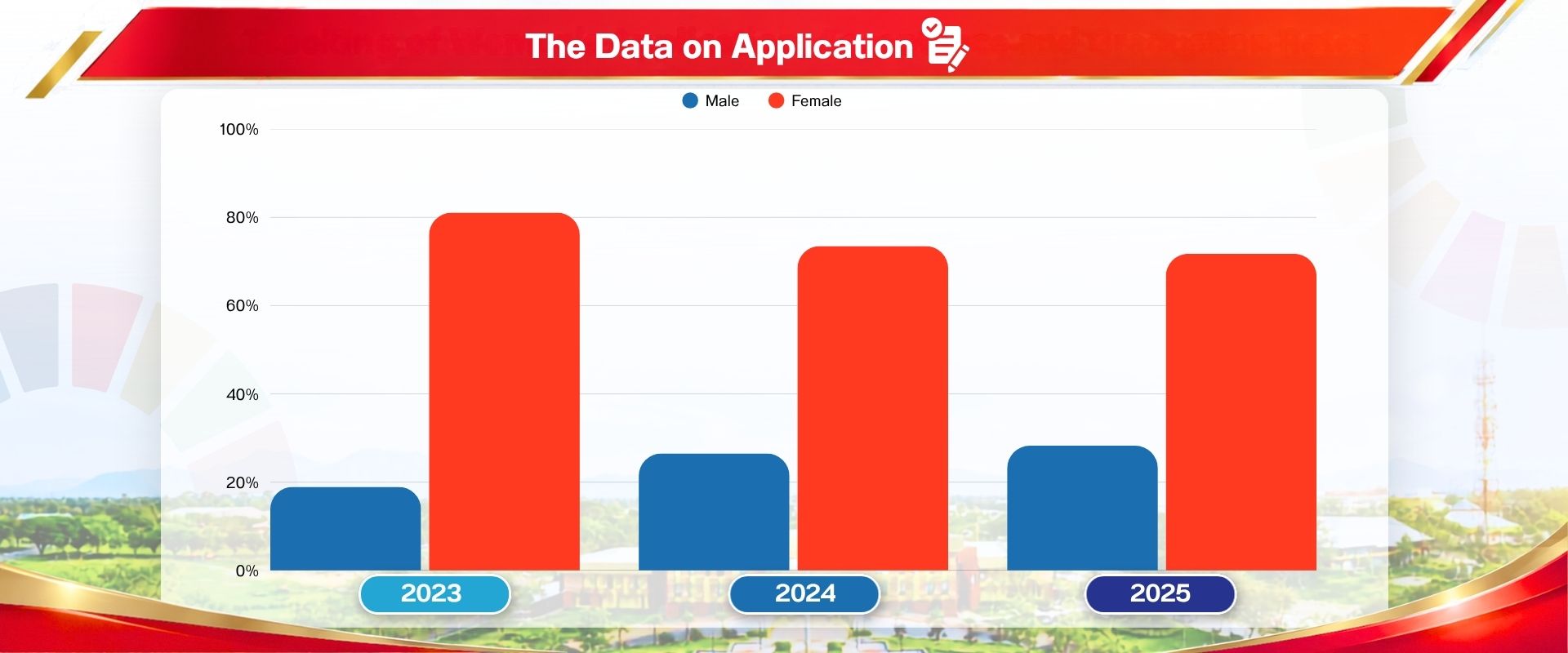
From 2023 to 2025, the proportion of female applicants to Walailak University consistently exceeded that of male applicants. In 2023, female applicants accounted for 81.06% of the total, while male applicants represented 18.94%. In 2024, there was a slight shift, with the proportion of female applicants decreasing to 73.51%, while the male proportion increased to 26.49%, indicating a modest rise in male participation. In 2025, female applicants continued to form the majority, accounting for 71.75% of the total, compared with 28.25% for male applicants. Overall, female applicants consistently constituted the majority of the applicant pool from 2023 to 2025. Based on the data, female participation in these fields remained higher than that of males.
The application data from 2023 to 2025 across STEM, Medicine, and Arts/Humanities/Social Sciences demonstrate that women consistently had strong access to higher education at Walailak University. In every academic discipline and across each year covered by the data, female applicants represented a substantial proportion of the applicant pool and, in most cases, significantly outnumbered male applicants.
In 2023, female applicants accounted for 81.06% of the total applicant pool, compared with 18.94% for male applicants. In 2024, female applicants continued to represent the majority, accounting for 73.51%, while male applicants accounted for 26.49%. This pattern continued in 2025, when women represented 71.75% of all applicants.
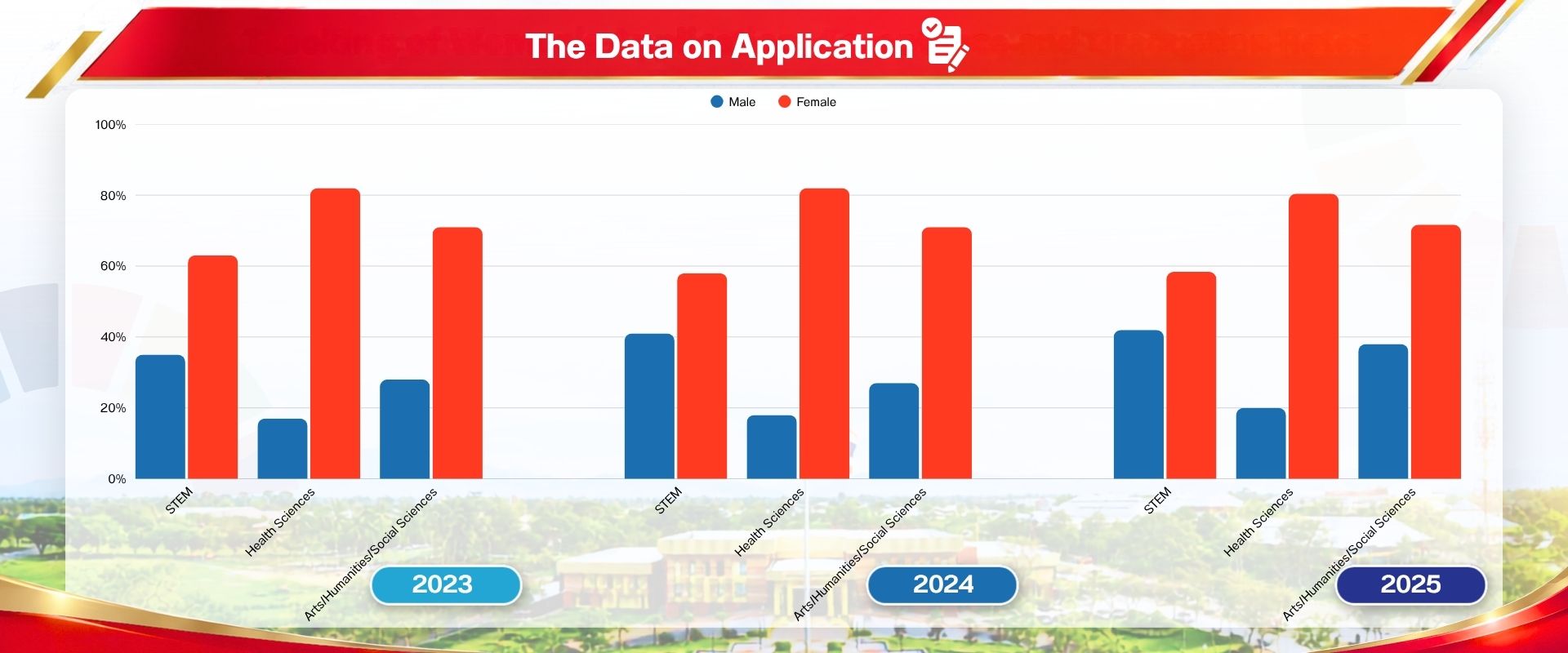
The 2025 data further demonstrate strong female participation across all three academic categories. In Arts/Humanities/Social Sciences, there were 12,201 female applicants compared with 4,822 male applicants, meaning that women accounted for approximately 71.67% of applicants. In STEM fields, women accounted for 58.38% of applicants, with 7,801 female applicants compared with 5,562 male applicants. In Medicine and Health Sciences, female applicants showed the highest level of participation, accounting for approximately 80.41% of applicants, with 16,788 female applicants compared with 4,091 male applicants.
These findings indicate that women have substantial and equitable access to higher education at Walailak University across a diverse range of academic disciplines, including STEM fields where women have historically been underrepresented in many contexts. The consistently high proportion of female applicants also suggests that women actively participate in the university’s admission process and have strong representation across different areas of study.
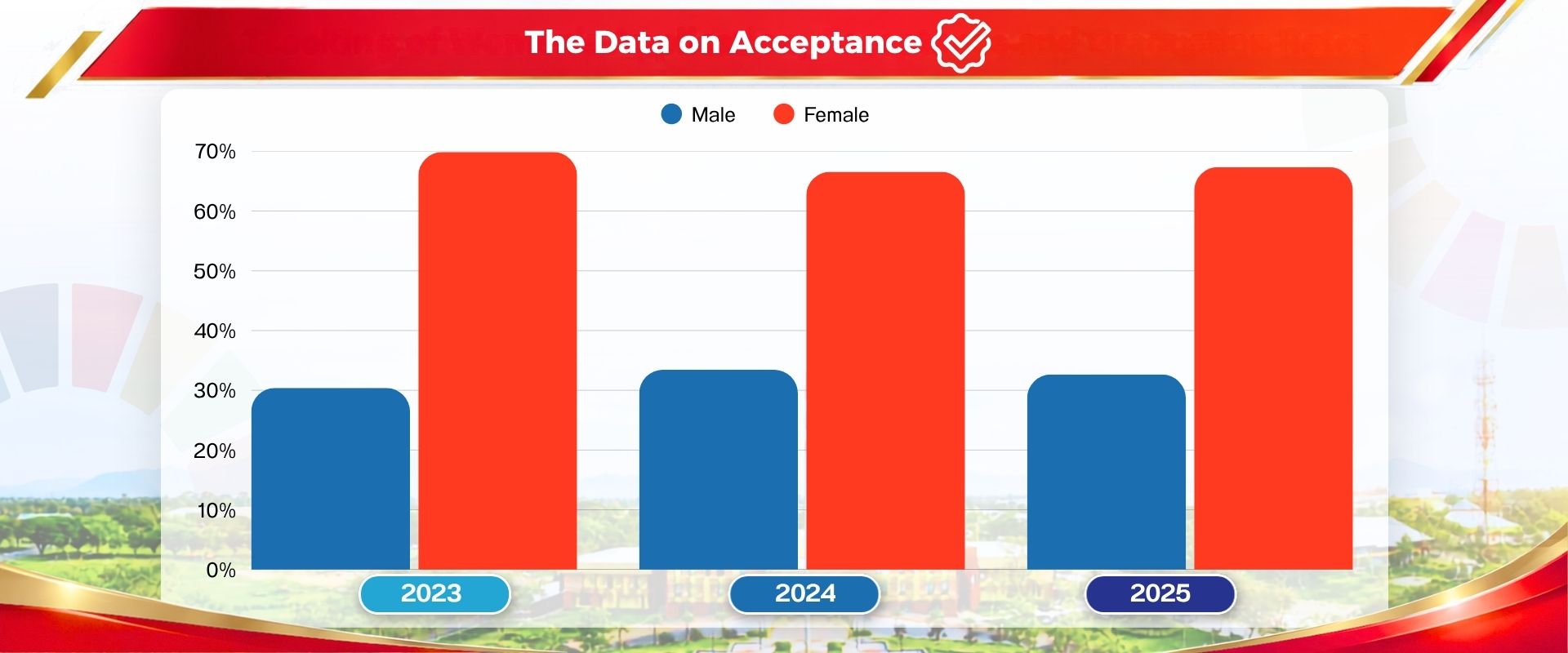
The acceptance data at Walailak University from 2023 to 2025 demonstrate a consistent trend in which female students were accepted at higher proportions than male students, although the gender gap gradually narrowed over the period.
In 2023, female students represented a significant majority of accepted applicants, accounting for 69.86%, compared with 30.14% for male students. In 2024, the proportion of female acceptances decreased to 65.56%, while male acceptances increased to 33.44%, indicating a gradual movement toward more balanced gender representation among accepted students.
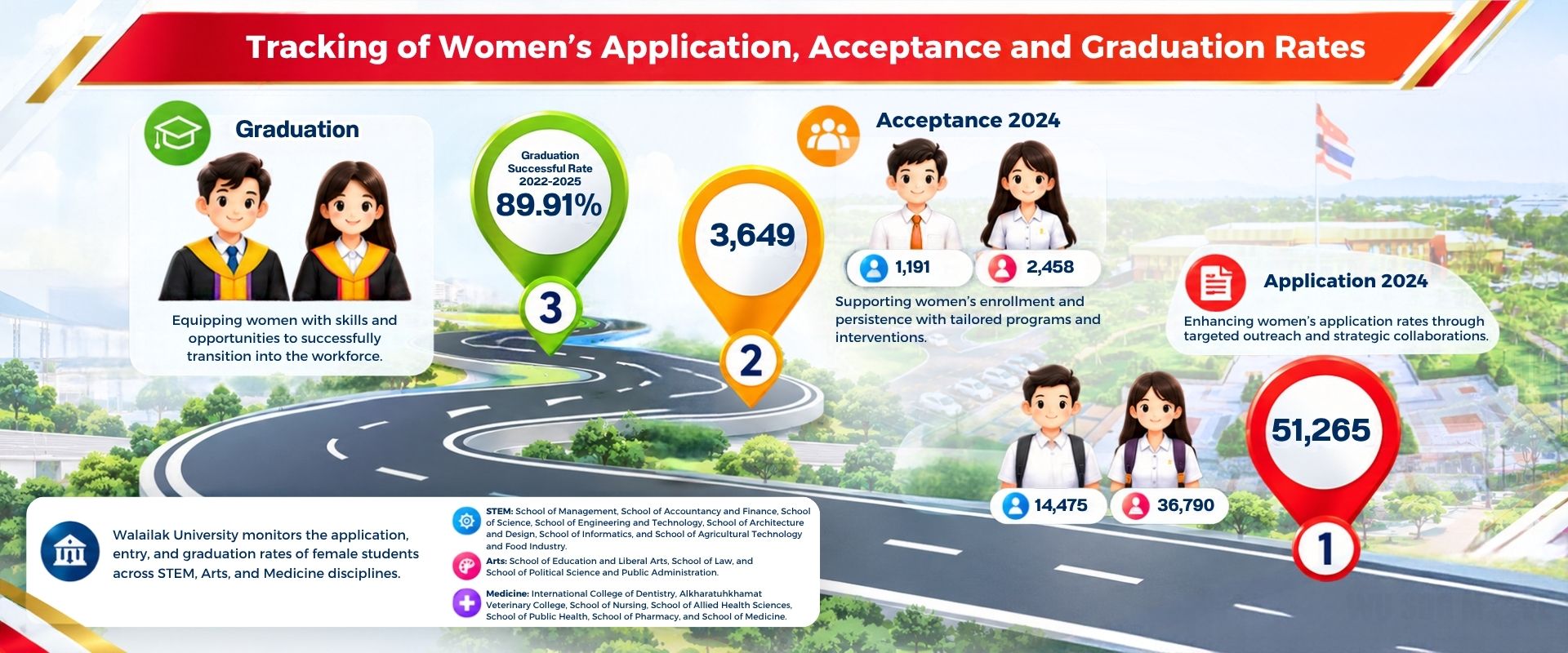
In 2025, female students continued to constitute the majority of accepted applicants. Of the 3,649 accepted students, 2,458 were women (67.36%), compared with 1,191 men (32.64%). Although the proportion of female acceptances increased slightly compared with 2024, women remained substantially represented among newly accepted students.
Overall, the data from 2023 to 2025 show that women consistently constituted the majority of accepted students at Walailak University. The university’s admission outcomes demonstrate continued access for women across the applicant pool while maintaining a relatively balanced representation of both genders among newly accepted students. These results support the university’s commitment to providing equitable opportunities for women and men throughout the admission process.
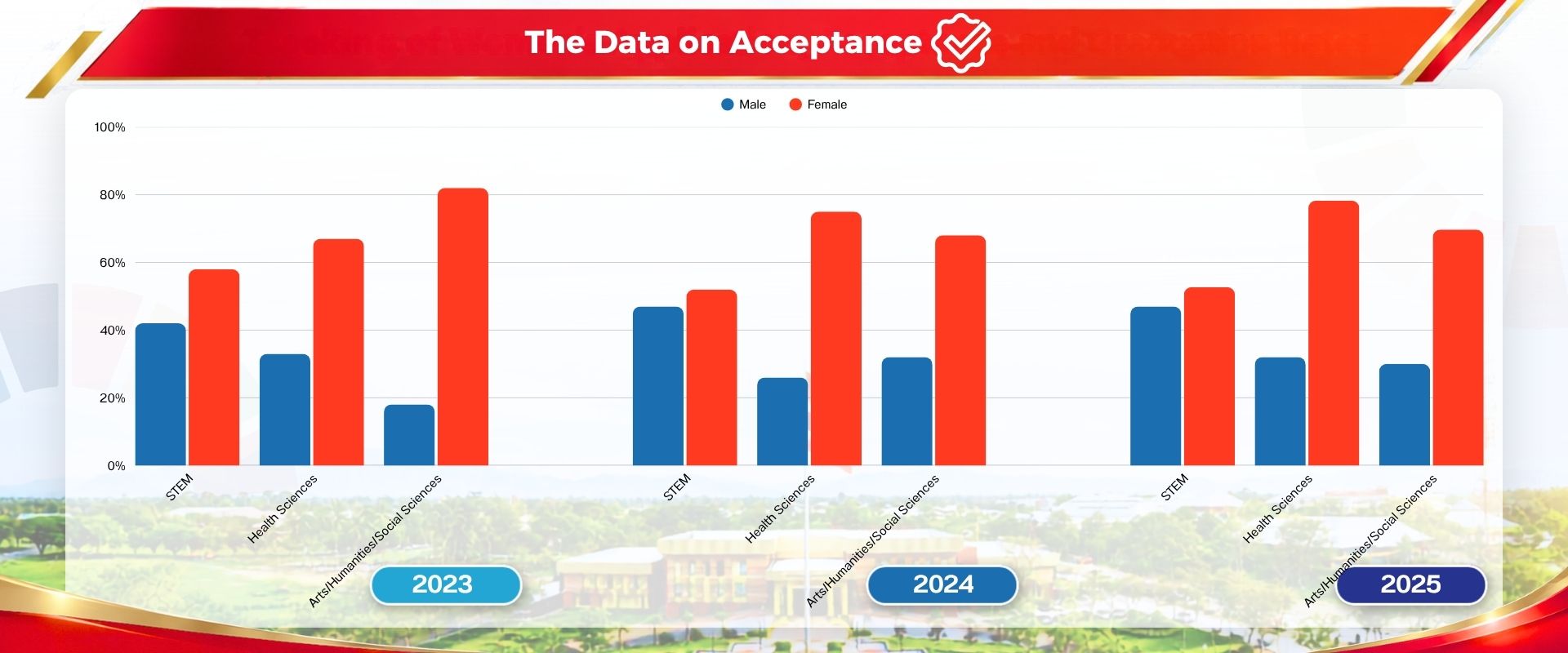
In 2025, Walailak University continued to demonstrate its commitment to promoting gender equality and ensuring equitable access to higher education across diverse academic fields. The university’s admission data show that female students represented the majority of accepted students in all three major academic categories: STEM, Medicine, and Arts and Humanities.
In STEM fields, 522 female students were admitted compared with 468 male students, meaning that women accounted for 52.7% of STEM admissions. In Medicine, female representation was particularly strong, with 775 female students compared with 215 male students, resulting in women comprising 78.3% of admissions in this field. In Arts and Humanities, 1,013 female students were admitted compared with 440 male students, with women accounting for 69.7% of total admissions.
Overall, the 2025 data demonstrate that female students maintained a strong presence across all major academic fields at Walailak University. Women constituted more than half of admitted students in STEM and nearly four-fifths of admitted students in Medicine, while also maintaining substantial representation in Arts and Humanities. These outcomes reflect the university’s continued efforts to provide inclusive and equitable opportunities for women to enter higher education across a broad range of disciplines.
Walailak University’s Statistical Monitoring System for Gender Diversity in Admissions
According to the diagnostic analysis and admission reports of the Center for Educational Services (CES), Walailak University systematically monitors gender-disaggregated application and acceptance data to assess women’s access to higher education. For the 2025 academic year, a total of 51,265 applicants from across Thailand applied to Walailak University, of whom 36,790 were female, representing 71.75% of the total applicant pool. Male applicants accounted for the remaining 28.25%.
Among the applicants accepted for admission in 2025, a total of 3,649 students were accepted, including 2,458 female students (67.36%) and 1,191 male students (32.64%). Female students therefore continued to constitute the majority of accepted students, demonstrating strong female participation in the university’s admission process.
Gender-Disaggregated Student Data Monitoring and Equitable Access to Higher Education
The Center for Educational Services (CES) has developed a dedicated website that systematically collects, organizes, and presents statistical data related to SDG 2, SDG 3, SDG 4, SDG 5, and other relevant student-related indicators. The website serves as an important data management and monitoring tool, demonstrating Walailak University’s commitment to promoting gender diversity, equality, and inclusion in higher education.
The collected data enable CES to identify and monitor trends in student participation and to assess potential barriers that may affect women’s access to and participation in higher education. In particular, the website provides annual statistics on the number of women students enrolled at Walailak University and continuously updates information on women students who have withdrawn, discontinued their studies, or participated in the University’s educational programs. This allows CES to monitor changes over time and use evidence-based information to support the development of measures that promote equitable access to higher education for women.
The statistical information is available through the Walailak University website at:
https://ces.wu.ac.th/registrar/refer/sdg2.asp?d=&y=2567&lang=

Figure: An example of the website displaying the data in 2025
In addition, CES has launched a separate website providing more detailed information on the distribution of male and female students across different academic programs. The data are categorized by Student Classification and presented on an annual basis, allowing CES staff to examine gender patterns across academic programs and student groups.
This detailed information supports CES in monitoring the participation and acceptance of female students, identifying changes in female student representation across different programs, and assessing whether women have equitable opportunities to enter and participate in higher education. The data also provide an evidence base for identifying areas where additional measures or support may be required to strengthen gender inclusion and participation at Walailak University.
The detailed student statistics are available at:
https://ces.wu.ac.th/registrar/student_total2.asp
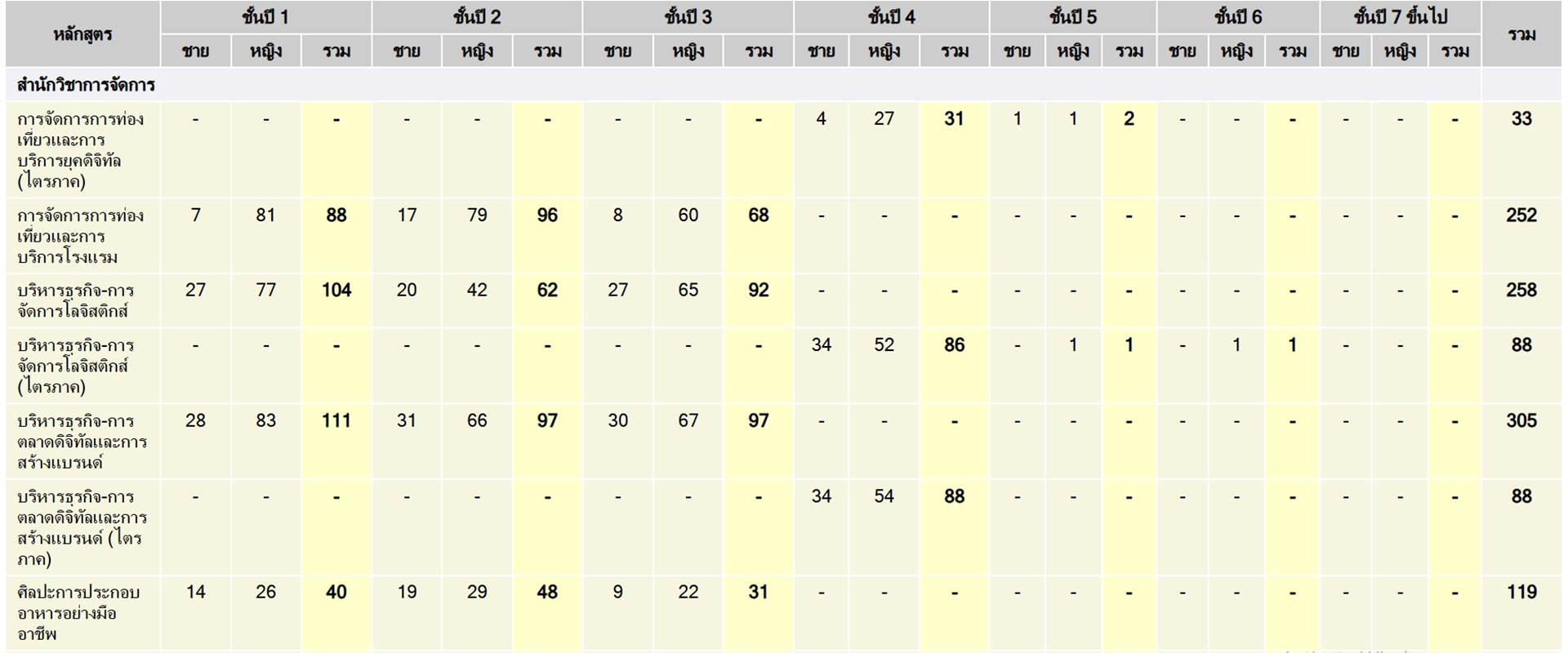
Figure: An example showing the information about the number of current FTE students, both women and men
Walailak University is committed to ensuring that women are not discriminated against in the admissions process and upholds the principle of equal opportunity for all applicants, regardless of gender. Women have consistently represented the majority of the University’s student population, reflecting its inclusive learning environment, supportive academic culture, and commitment to gender equality.
To promote transparency and support continuous improvement, Walailak University, through the Center for Educational Services (CES) and its Admission Division, systematically collects, measures, and monitors data on women’s applications, acceptance, and enrollment rates on an annual basis. This systematic monitoring enables the University to identify trends, assess potential barriers to women’s participation, and develop or strengthen measures that support equitable access to higher education.
The University applies this approach across all academic disciplines, including STEM and Medicine, to ensure that women have fair opportunities to enter and participate in diverse fields of study. By maintaining a comprehensive and publicly accessible database of gender-disaggregated admissions statistics, Walailak University demonstrates its ongoing commitment to gender equality, women’s empowerment, transparency, and fair and inclusive admissions practices.
Walailak University’s systematic measurement and diagnostic analysis of gender-disaggregated admission and student data provide an important foundation for promoting gender equality and inclusive access to higher education. By measuring female and male application, acceptance, enrollment, and graduation outcomes, the university can identify participation trends, assess progress toward equitable educational opportunities, and diagnose potential disparities across academic disciplines. These evidence-based assessments support informed decision-making and enable the university to identify areas where additional measures, guidance, or academic support may be beneficial.
The continuous measurement and monitoring of these indicators also generate positive impacts for students, university administrators, and the wider community. Female applicants can benefit from greater transparency and confidence in the fairness of the admissions process, while current students benefit from institutional efforts to identify barriers and strengthen inclusive learning opportunities. At the institutional level, reliable statistical evidence supports strategic planning, resource allocation, and the development of targeted measures to promote women’s participation and educational success, including in STEM, Medicine, and other fields where gender disparities may persist.
Furthermore, Walailak University’s publicly accessible statistical monitoring systems strengthen accountability and transparency by making relevant student data available for review and assessment. The measurement of changes over time allows the university to evaluate whether its approaches are achieving the intended outcomes and to refine its practices in response to emerging needs. By integrating diagnostic analysis with continuous measurement and evidence-based improvement, WU can strengthen its capacity to identify inequalities, support students throughout their educational journeys, and promote fair opportunities for academic progression and graduation.
Through these ongoing efforts, Walailak University reinforces its commitment to gender equality, women’s empowerment, and inclusive higher education. The systematic measurement of admission and student outcomes provides a practical basis for assessing institutional progress, improving educational support, and ensuring that women and men can pursue their academic ambitions according to their abilities and interests. In the long term, these efforts can contribute to a more inclusive academic environment, stronger educational attainment, and the development of graduates equipped to contribute to social and economic development