Electricity usage per year.

Electricity usage per year.

Energy and Climate Change (EC)
Energy and Climate Change (EC) Electricity Usage per Year (in Kilowatt hour) In 2025, Walailak University’s total electricity consumption was 10,977,613.39 kWh. Within the main campus, the top three areas with the highest electricity consumption were the Student Dormitory Buildings, Other Buildings, and Administration Buildings. Based on the total campus population of 17,598, the electricity usage per capita was 623.8 kWh per person. The Electricity Consumption of Each Building at Walailak University (2023 - 2025)Source of data : Division of Service Central.The total energy consumption across the university during the same period was 10,977,613.39 kWh/year. Based on these figures, the ratio of renewable energy production to total energy usage was calculated to be 31.64%. Related SDGs 7 Goal 7: Affordable and clean energy 13 Goal 13: Climate action
Read More
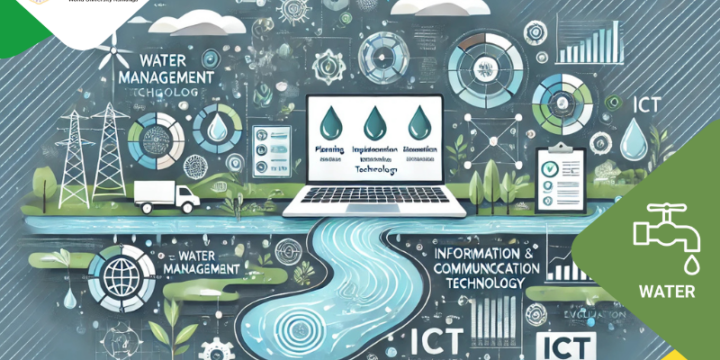
Planning, implementation, monitoring and/or evaluation of all programs related to Water Management through the utilization of Information and Communication Technology (ICT)

Planning, implementation, monitoring and/or evaluation of all programs related to Water Management through the utilization of Information and Communication Technology (ICT)

Water
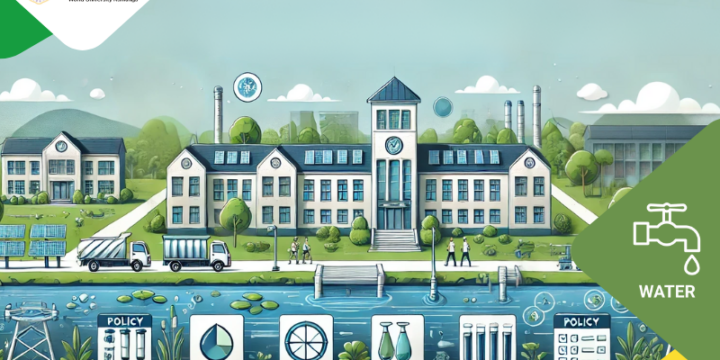
Water (WR) Planning, implementation, monitoring and/or evaluation of all programs related to Water Management through the utilization of Information and Communication Technology (ICT) • PlanningAnalysis of Water Management Needs and Usage Analytics: In this step, WU assess the water management needs by analyzing water usage in various buildings and wastewater management. This involves collecting data on water consumption, including the number of users and types of water used, to determine overall water usage. Reference of data : Division of landscaping and building• Implementation of Equipment and ICT SystemsWU install the necessary equipment and ICT systems, including water level monitoring sensors that track the amount of water in tanks or collected rainwater. These sensors facilitate real-time tracking of water levels and provide alerts when levels exceed certain thresholds, which is particularly…
Read More
Water pollution control in campus area (WR.5)

Water pollution control in campus area (WR.5)

Water
Water (WR) Water pollution control in campus area Walailak University has policies and guidelines on wastewater treatment from buildings and all places across the campus that are based on legally required standards and requirements to protect the ecosystems, human life, and wildlife around the campus. Besides the guidelines and policies, WU has a manual on wastewater treatment on campus. - Wastewater Treatment Manual - Reference of data : Wastewater Treatment ManualThe university has realized that the staff working on building maintenance must be supported by the university so that the staff can perform preliminary checks and tackle any problems with proper procedures. The procedures for wastewater treatment at WU prevent the wastewater from entering the ecosystems around the campus using standard measures and procedures. Regarding human life, the treatment procedures…
Read More
Consumption of treated water (WR.4)

Consumption of treated water (WR.4)

Water
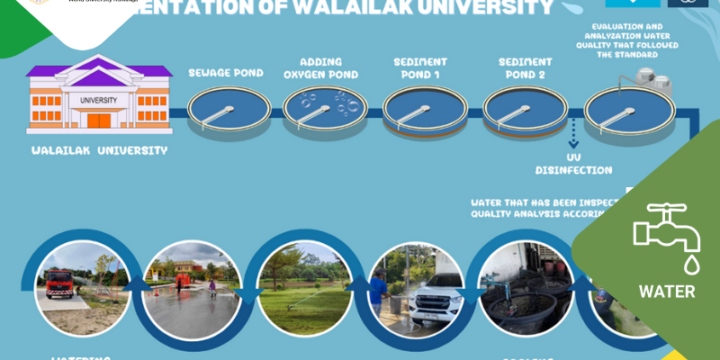
Water (WR) Consumption of treated water The total water usage at Walailak University is 793.00 cubic meters per day, with all water entering the wastewater treatment system. During this process, approximately 5% of the water is lost, equivalent to 39.65 cubic meters per day. As a result, the amount of treated water available for use is 753.35 cubic meters per day.The university utilizes 100% of this treated water for various purposes, including watering plants on campus, cleaning road, sprinkler, car wash station, cooling water for the incinerator, and aquaculture. These activities represent a comprehensive and sustainable use of treated water within the campus, minimizing waste and promoting resource conservation. Picture : Water Recycling Program Related SDGs 6 Goal 6: Clean Water and Sanitation 13 Goal 13: Climate action
Read More
Water-efficient appliances usage (WR.3)

Water-efficient appliances usage (WR.3)

Water
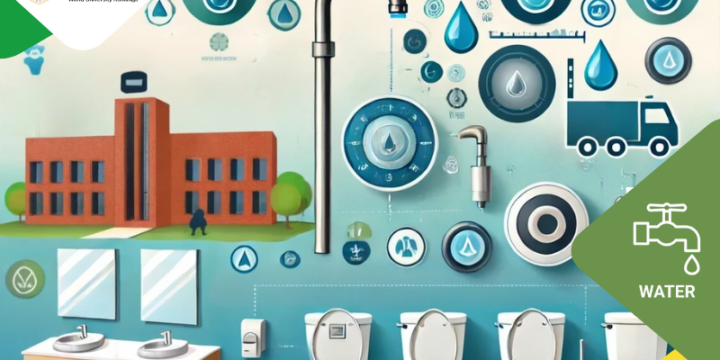
Water (WR) Water-efficient appliances usage Walailak University has a policy to promote reduced water usage and efficient water management within the university for maximum benefit. The university has applied building standards aimed at minimizing water use. Announcement of Walailak University Subject : Water Reuse Guidelines. Thai version see : https://bit.ly/3G0jyQv This promotion could be implemented for 1,824 units which includes all toilet bowls in the university.• FaucetsWU have installed self-closing faucets instead of swivel faucets, which can control and limit water usage effectively. Picture : Automatic faucets• Urinal flush valvesThese have been replaced with water-saving versions (6 liters), which have reduced water consumption by approximately 1-2 liters. Picture : Sensor urinal • Toilet bowls valvesTraditional squat and sitting toilets, which contribute to water wastage, have been replaced with more efficient…
Read More
Water recycling program implementation (WR.2)

Water recycling program implementation (WR.2)

Water
Water (WR) Water recycling program implementation Walailak University has introduced a water recycling program to support sustainable water use. In 2024, the university's daily water consumption for domestic purposes reaches 793 cubic meters, with all wastewater directed into the treatment system. Approximately 5% of this water, or 39.65 cubic meters per day, is lost during treatment. Consequently, 753.35 cubic meters of treated water is available daily for reuse in the following activities : 1. Watering trees and flowers around the constructed wetland using a pumping and sprinkler system. 2. Watering trees along roads and around the university, which requires minimal water due to the rainy climate in southern Thailand. 3. Fish farming with treated water that has passed quality control checks. 4. Washing university-owned vehicles. 5. Cleaning roads within the…
Read More
Water Conservation Program Implementation (WR.1)

Water Conservation Program Implementation (WR.1)

Water
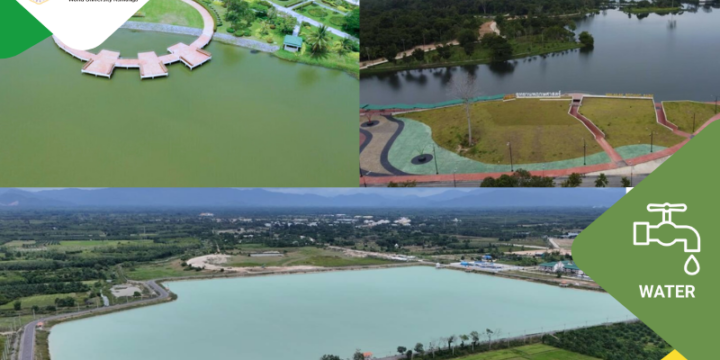
Water (WR) Water Conservation Program Implementation Picture : Measure the total volume of water used in the university that is taken from the mains supply, and extracted from various detention ponds and canalsWalailak University is in Southern Thailand, covering a total area of 21,196,440 square meters, making it the largest university in the country by land area. Due to its location, the university experiences drought during the summer and heavy rainfall during the rainy season. To manage water resources effectively, the university stores water in various reservoirs, ponds, and lakes, with a combined area of 1,672,217 square meters and a total storage capacity of 13,857,094 cubic meters. This water management approach plays a crucial role in sustainable water management on campus, preventing flooding during the rainy season and securing water…
Read More
Greenhouse gas emission reduction program (EC.7)

Greenhouse gas emission reduction program (EC.7)

Energy and Climate Change (EC)
Energy and Climate Change (EC) Greenhouse gas emission reduction program Walailak University has implemented a comprehensive greenhouse gas (GHG) emission reduction program that spans all 3 emissions scopes, underscoring its unwavering commitment to sustainability and environmental stewardship. This program addresses initiatives across direct emissions, indirect emissions from energy use, and other indirect emissions within the University’s operations.Scope 1 : Direct Emissions• Stationary CombustionThe University conducts regular maintenance and inspections of its combustion and power generation systems to ensure they operate efficiently and within emissions standards.• Mobile CombustionThe University has transitioned to electric vehicles for its fleet, including minibuses, delivery vans, and security vehicles, significantly reducing reliance on combustion fuels. In 2024, Walailak University successfully reduced greenhouse gas emissions by 47.31 tons of carbon dioxide equivalent through the use of electric…
Read More
Number of innovative program(s) in energy and climate change (EC.9)

Number of innovative program(s) in energy and climate change (EC.9)

Energy and Climate Change (EC)
Energy and Climate Change (EC) Number of innovative program(s) in energy and climate change Walailak University has implemented a series of innovative programs in energy and climate change, contributing to the advancement of sustainability in these fields. Solar Roof Installation at the Center for Scientific and Technological Equipment This project enhances energy efficiency by harnessing solar power, reducing dependence on conventional energy sources. Reference of data : Real-time renewable energy monitoring program Automatic air conditioning on-off control system based on class schedule This platform is designed to help communities manage water resources for agricultural purposes by leveraging mobile cloud computing technology. The web application allows real-time monitoring, data collection, and decision-making on water usage, irrigation scheduling, and resource allocation, ensuring more efficient and sustainable water management. Picture : The architecture…
Read More